Disclaimer: The prices and information presented on this page reflect a snapshot at the time of research and may change at any time without prior notice.

Aisha
09 March 2026


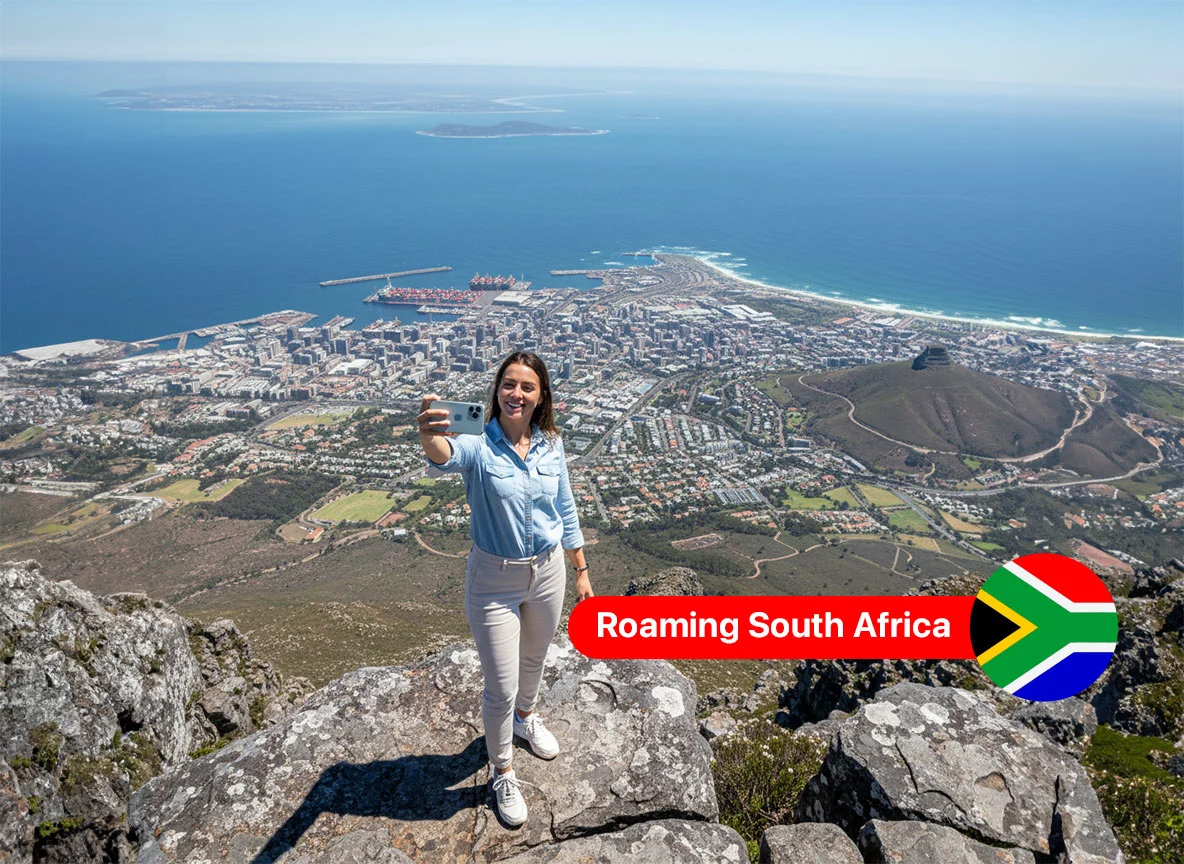
South Africa is one of the world's most diverse travel destinations, from Cape Town's Atlantic coastline and the Winelands to the game reserves of the Kruger National Park and the Drakensberg mountains. Staying connected across all of it requires more planning than most travellers expect. Urban coverage in Cape Town, Johannesburg, and Durban is strong on multiple operators. Safari regions are a different story. Network availability in remote game reserves and rural areas depends heavily on which operator you are using, and international roaming costs in South Africa sit outside the low-cost zones of most major global carriers. This guide covers how roaming works in South Africa, which networks are available, what coverage looks like beyond the cities, and the practical case for a travel eSIM on longer or multi-region trips.
South Africa's mobile market is led by Vodacom, the largest operator with the widest coverage footprint. MTN is the second major player, with strong national coverage and extensive investment in rural infrastructure. Cell C is a smaller third operator offering competitive prepaid rates. Telkom Mobile operates mainly in urban areas.
For most international visitors roaming in, Vodacom and MTN are the most common partner networks for major global carriers. Both operators have 4G LTE coverage in cities and along main highway corridors. Coverage maps diverge significantly once you move into less-populated areas.
The Kruger National Park presents the most common coverage question for international travellers. Vodacom has historically had stronger coverage within the park itself, including the main rest camps. MTN coverage is improving but more variable in the deeper parts of the park. In private game reserves bordering Kruger, connectivity is often limited to the lodge reception area or specific viewpoints regardless of operator.
South Africa sits in a worldwide or Africa zone for most major international carriers, meaning it is one of the higher-cost roaming destinations for travellers from Europe, North America, Australia, and Asia. Without a roaming add-on, data charges can reach several dollars per megabyte on some carriers.
Always confirm current roaming rates with your home carrier before departure, as rates and zone classifications change regularly.
Set up roaming or your eSIM before you board. South Africa's main international airports, O.R. Tambo in Johannesburg and Cape Town International, have strong Wi-Fi, but sorting out connectivity in the arrivals queue is avoidable. Configure your roaming add-on or install your eSIM QR code at home before departure.
Turn off data roaming until your plan is confirmed. If you land without a confirmed add-on, disable data roaming immediately to avoid pay-as-you-go charges. Use airport Wi-Fi to activate your plan first.
Vodacom covers more of Kruger's interior. For safari travellers, Vodacom's partner network coverage within the Kruger National Park is generally better than MTN's in the main camp areas. Some private reserves have no coverage at all from any operator.
Download offline maps before entering game reserves. Google Maps and Maps.me offline areas for the Kruger region and major game reserve corridors are worth downloading before you leave the city. Do not rely on a data connection for navigation in the park.
Local SIMs are affordable and easy to buy. If you are staying in South Africa for a week or more and do not mind the SIM-swap process, Vodacom and MTN prepaid tourist SIMs are available at OR Tambo and Cape Town International on arrival. Rates are competitive. You need your passport for purchase.
South Africa is one of the destinations where the roaming cost argument for a travel eSIM is clearest. For travellers from the UK, Australia, or Canada, South Africa sits in a higher-cost roaming zone. A ten-day Cape Town and safari itinerary means ten days of daily roaming pass charges, which compounds into a meaningful bill.
A fixed-price travel eSIM for the trip duration eliminates that calculation. You pay once, you know what data you have, and there are no billing surprises when you return. On a dual-SIM device, your home SIM stays active for banking OTPs and any incoming calls you need to receive. The eSIM handles South African data.
For multi-region southern Africa itineraries, including South Africa combined with Botswana, Zimbabwe, or Namibia, separate fixed-price eSIMs per destination are typically much more cost-effective than stacking daily roaming passes across multiple countries.
South Africa rewards the traveller who moves around. A Johannesburg arrival, Garden Route road trip, Cape Town stay, and Kruger safari finish is a typical itinerary, covering thousands of kilometres across varying coverage environments. Navigation, accommodation bookings, game drive notifications, and Bolt or Uber in the cities all need reliable data across all of it.
TurkSIM connects to Vodacom and MTN in South Africa, giving access to the two networks with the broadest national coverage reach. Vodacom's edge in the Kruger interior is particularly relevant for safari travellers who want to maintain connectivity in the main rest camps.
For travellers from the UK, Australia, Canada, or Singapore, where South Africa sits in a high-cost roaming zone, the arithmetic of daily passes over a 10 to 14-day itinerary makes a fixed-price eSIM the more cost-effective option. Install it before you board, turn it on when you land, and the connectivity question is settled before you even clear customs at O.R. Tambo.
The major operators are Vodacom, MTN, Cell C, and Telkom Mobile. Vodacom and MTN have the broadest national coverage, including rural areas and most game reserve regions. Cell C and Telkom Mobile are more focused on urban coverage.
Yes, but it varies by operator and location. Vodacom generally has better coverage within the park, particularly at the main rest camps such as Skukuza, Satara, and Letaba. MTN coverage is improving. Deep bush and private reserves may have no signal from any operator.
Not necessarily. International roaming through your home carrier or a pre-installed travel eSIM both provide data connectivity without needing a local SIM. A local SIM can be more cost-effective for longer stays (two weeks or more) but requires SIM swapping and a passport at purchase.
Yes. Both Uber and Bolt operate in Cape Town, Johannesburg, and Durban. A data connection is required. Make sure roaming or your eSIM is active before you need transport at the airport.
5G is available in parts of Johannesburg, Cape Town, and Durban through Vodacom, MTN, and Telkom Mobile. Coverage is still primarily urban. Most visitors connect at 4G LTE for the majority of their trip.
TurkSIM eSIMs are installed via a QR code before departure. On a dual-SIM device, the eSIM runs alongside your home SIM. Set the eSIM as your data line and your home SIM handles calls and SMS. No physical SIM swap needed.
Traveling to another country? Find roaming information for other destinations here: