Disclaimer: The prices and information presented on this page reflect a snapshot at the time of research and may change at any time without prior notice.

Liam
27 March 2026


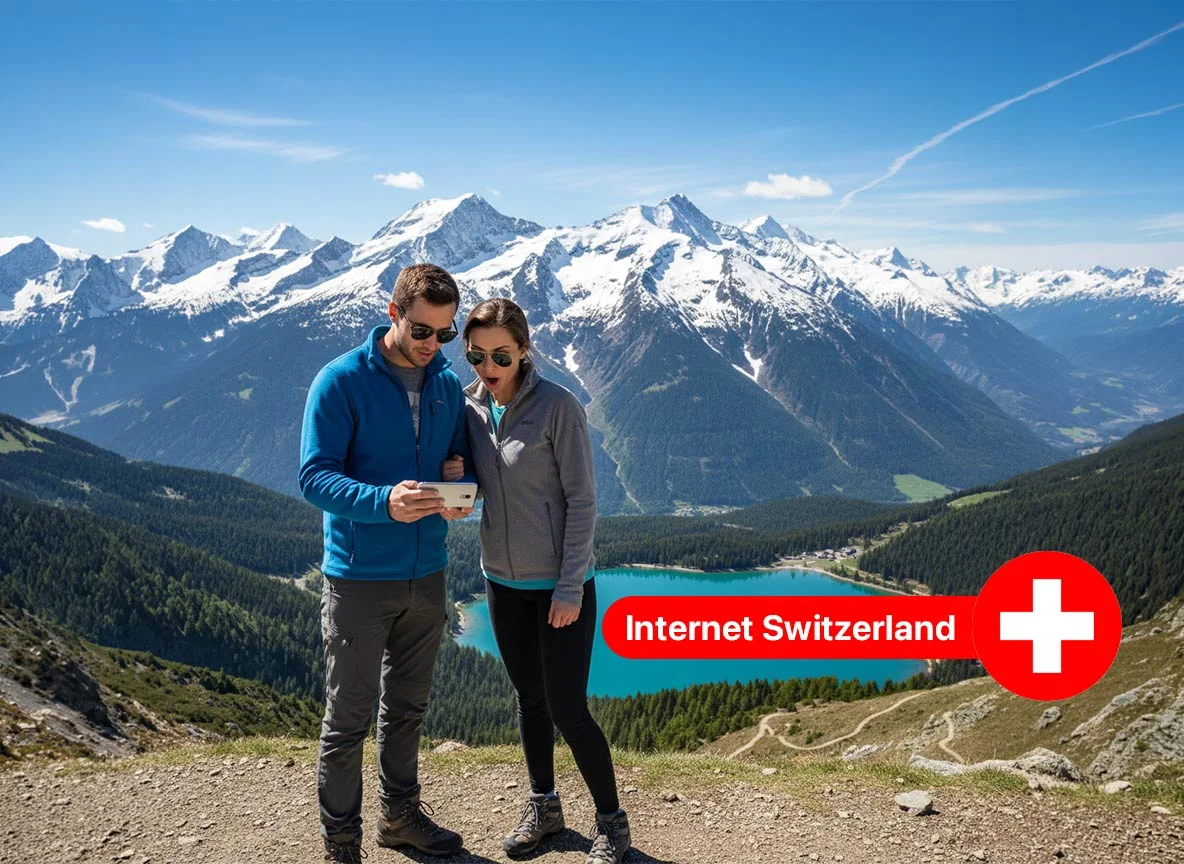
Switzerland is one of those destinations that looks incredible in photos but can be surprisingly frustrating when it comes to staying connected. You step off the train in Interlaken or arrive at Zurich Airport, and the first thing you need is a reliable internet connection: for maps, for hotel confirmations, for letting someone know you made it. The problem is that Switzerland sits outside the EU, which means most European travellers lose their free roaming the moment they cross the border. American and Asian visitors face even steeper per-megabyte charges. Free public Wi-Fi exists in stations and hotels but is rarely fast enough for video calls or real-time navigation in the mountains. This guide covers every practical option for getting mobile internet in Switzerland, from carrier roaming to local SIM cards and travel eSIMs, so you can pick the one that fits your trip.
Switzerland is not part of the European Union. That single fact changes everything about mobile data for visitors. EU residents who enjoy free "Roam Like at Home" coverage across 30 European countries will find that their allowance stops at the Swiss border. Some carriers (like O2 UK) include Switzerland in their European roaming zone, but most do not. For US carriers like AT&T and Verizon, Switzerland falls under the standard international day pass rates of around $10–12 per day. Canadian carriers charge similar daily fees.
Switzerland has three main mobile networks: Swisscom (the largest, with the best rural coverage), Sunrise (strong in cities and along transport corridors), and Salt (good value, solid urban coverage). All three offer 4G/LTE across the country, and 5G is increasingly available in Zurich, Geneva, Basel, Bern, and other urban centres. Even in mountain areas and along scenic train routes like the Glacier Express, coverage is generally reliable thanks to Switzerland’s investment in infrastructure along rail tunnels and valleys.
The challenge for visitors is accessing these networks affordably. Roaming through your home carrier is the easiest but most expensive route. A local prepaid SIM works well but requires finding a shop and going through activation. A travel eSIM combines the convenience of instant activation with local network rates.
The table below compares the main ways to get internet on your phone during a trip to Switzerland. Costs are approximate and vary by carrier and plan.
Getting mobile internet sorted before you arrive makes the rest of your trip much smoother. Here are the most useful tips based on how Swiss connectivity actually works.
Check if your carrier includes Switzerland. Some UK carriers like O2 include Switzerland in their European roaming zone at no extra cost (with a 25 GB cap). Vodafone UK places Switzerland in Zone B (Euro Roam), charging £2.57 per day. EE may charge £2.59/day or more depending on your plan. Always verify before you fly, because Switzerland’s non-EU status catches many travellers off guard.
Download offline maps before you leave. Google Maps and Apple Maps both support offline downloads for Swiss cities and regions. This is especially useful if you plan to hike or drive through areas where cell coverage might be weaker, like high mountain passes or remote valleys in the Engadin.
Buy your eSIM before departure. Swiss mobile shops at airports sell physical prepaid SIMs from Swisscom, Sunrise, and Salt, but none of them currently sell eSIMs for tourists at the airport. If you want an eSIM, purchase it online before your trip and scan the QR code while you still have Wi-Fi at home.
Mind the border crossings. Switzerland shares borders with France, Germany, Italy, Austria, and Liechtenstein. If you take a day trip to Milan or Chamonix, your phone may switch networks and trigger different roaming rates when you cross back. A multi-country eSIM or a Europe-wide plan avoids this problem entirely.
Use SBB Free Wi-Fi on trains. Swiss Federal Railways (SBB) offers free Wi-Fi on most InterCity and InterRegio trains. The connection is decent for messaging and light browsing but struggles with video calls or large downloads. It requires accepting terms through a browser portal.
Tethering works with most eSIMs. If you are travelling with a tablet or laptop, most travel eSIMs support tethering (hotspot sharing). This means one eSIM plan can cover multiple devices. Check the provider’s terms before purchasing, as some limit hotspot usage.
For most visitors, a travel eSIM offers the best balance of convenience, cost, and reliability. Here is why.
Switzerland prepaid SIM cards are a solid option if you do not mind visiting a shop. But the activation process requires ID verification, and none of the three Swiss carriers currently sell tourist eSIMs at the airport. If your flight lands at 10pm or you have a tight connection to Lucerne, buying a physical SIM is not always practical.
Carrier roaming works without any setup. But the costs add up quickly, especially for visitors from outside Europe. A US traveller paying $12 per day for 10 days spends $120 on roaming alone. A UK traveller on a Vodafone plan without European roaming included could pay £78 for the same period. Neither of those figures includes overage charges for exceeding daily data limits.
A travel eSIM lets you pre-purchase a data package (say, 5 GB or 10 GB for 7–30 days), install it before you leave home, and start using it the moment you land. There is no need to find a shop, show ID, or worry about activation delays. Your home SIM stays active in dual-SIM mode, so you can still receive calls, texts, and banking codes on your regular number.
For travellers combining Switzerland with other European countries (a common itinerary: Zurich, then Munich, then Milan), a Europe eSIM covers all three stops with one plan. No SIM swapping, no tracking which carrier charges what in each country.
Switzerland packs an extraordinary amount into a small country. You might start your morning at a Zurich café, take a scenic train through the Bernese Oberland, and end the day beside Lake Geneva. Each transition demands reliable connectivity: for train schedules, for finding the right platform at Bern station, for checking whether the cable car to Schilthorn is running.
TurkSIM’s Switzerland eSIM connects to Sunrise and Swisscom, covering both urban hubs and mountain regions. Whether you are navigating the narrow streets of Lucerne’s old town or uploading photos from the top of Jungfraujoch, the connection runs through established Swiss infrastructure rather than a distant roaming agreement.
For travellers on a European tour, the Europe eSIM from TurkSIM covers 36 countries in a single plan. Cross from Switzerland into Italy or France without changing settings, buying a new SIM, or worrying about border-triggered rate changes. One purchase, one QR code, continuous coverage.
The dual SIM advantage matters especially in Switzerland. Banking apps, airline check-in codes, and two-factor authentication messages often arrive via SMS to your home number. With TurkSIM handling data and your home SIM staying active for calls and texts, you never miss an important message. You also avoid the classic mistake of accidentally using your home carrier’s data and triggering a roaming charge.
No. Switzerland is not an EU member and is not covered by the EU’s Roam Like at Home regulation. Some carriers include Switzerland in their European roaming zones voluntarily, but most charge an extra daily fee. Always check your carrier’s roaming policy for Switzerland specifically before you travel.
Yes. There are shops at Zurich, Geneva, and Basel airports that sell prepaid SIM cards from Swisscom, Sunrise, and Salt. You will need to show your passport for ID verification. eSIMs for tourists are not available from Swiss carriers at the airport.
Swisscom has the widest coverage, especially in rural and mountain areas. Sunrise performs very well in cities and along major transport routes. Salt offers good value with solid urban coverage. For visitors, a travel eSIM that connects to Swisscom or Sunrise gives you the best overall experience.
For standard use (maps, messaging, email, social media, and occasional video calls), 3–5 GB per week is usually sufficient. If you plan to stream video or make frequent video calls, aim for 7–10 GB. Downloading offline maps before your trip reduces data consumption significantly.
Free Wi-Fi is available at most hotels, many restaurants, and on SBB trains. Quality varies: hotel Wi-Fi is generally reliable, train Wi-Fi can be slow during peak hours, and outdoor coverage is essentially nonexistent. For reliable connectivity throughout the day, mobile data is necessary.
Yes. A Europe eSIM from TurkSIM covers Switzerland and 35 other European countries in a single plan. This is ideal for travellers visiting multiple countries, as you do not need to buy separate SIMs or track different roaming rates at each border.
Yes. Even with a travel eSIM, you need to enable data roaming in your phone settings for it to connect to the local Swiss network. This is a phone-level setting, not a carrier charge. The eSIM uses the local network directly, so no roaming fees from your home carrier apply.
Planning your connectivity for another destination?