Disclaimer: The prices and information presented on this page reflect a snapshot at the time of research and may change at any time without prior notice.

Liam
07 May 2026


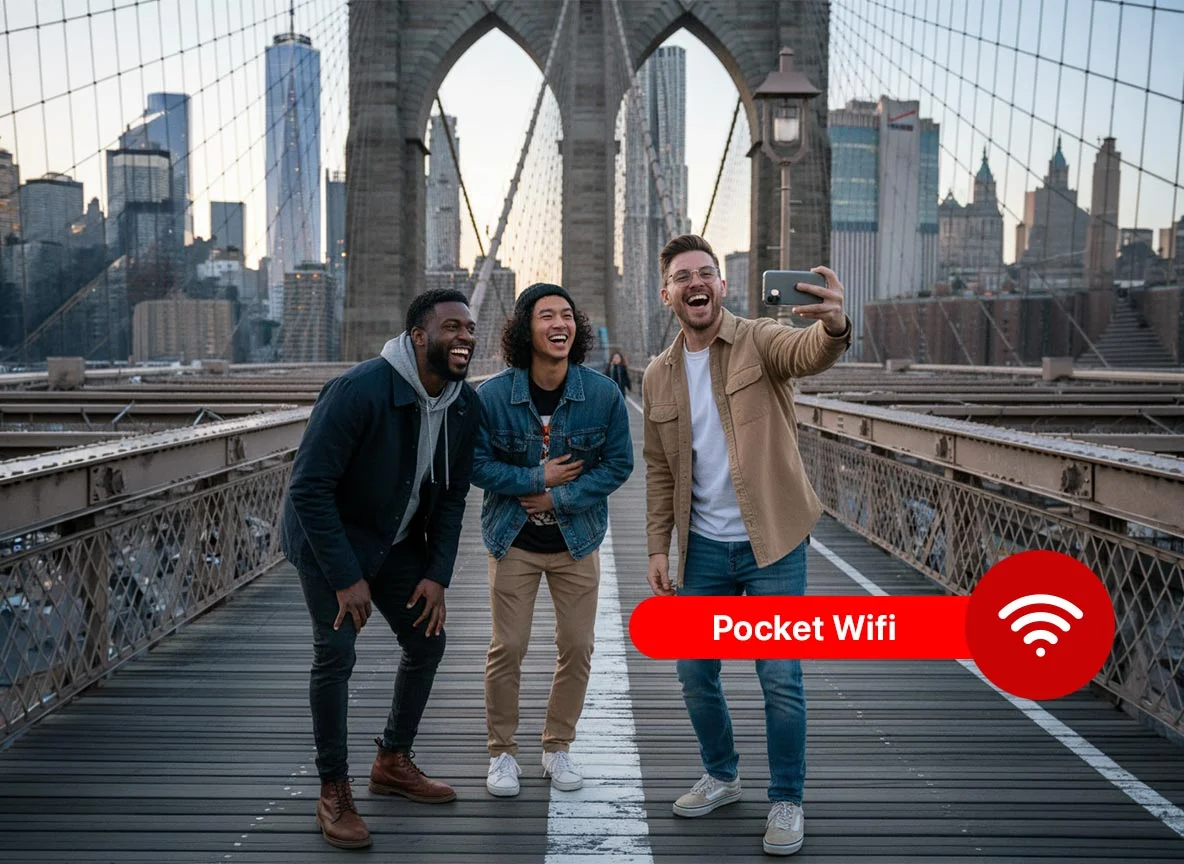
Why does a Verizon TravelPass customer pay USD 168 for two weeks of Manhattan roaming when an NYC-area eSIM costs USD 8 to USD 18 for the same period? The arithmetic is the same on AT&T International Day Pass at USD 12 a day and on Vodafone UK Global Roam Plus at GBP 6 a day, both of which stack up across a 14-day Manhattan-Brooklyn-Queens trip. The 70 million tourists who arrive at John F. Kennedy (JFK), LaGuardia (LGA), or Newark Liberty (EWR) each year face that math at touchdown. New York's Pocket WiFi rental market is anchored by Verizon and T-Mobile USA wholesale agreements, with hotel-delivery services dominating the Manhattan and Brooklyn boutique-hotel strips and airport-counter rentals limited to JFK Terminal 4. T-Mobile USA's Magenta plan customers skip the math entirely.
Pocket WiFi in New York is a portable LTE or 5G hotspot rented for the trip. The device holds a US data SIM and broadcasts a private WiFi network for the traveller's phones, tablets, and laptops. Three carriers anchor the rental fleet inside Manhattan: Verizon, AT&T, and T-Mobile USA. Verizon holds the strongest 5G across Midtown, the Financial District, the Upper East Side, the Upper West Side, and the Manhattan-bridges approach to Brooklyn. AT&T matches Verizon in Midtown and runs the strongest signal in the Times Square broadcast zone and at the World Trade Center observation deck. T-Mobile USA covers the same Manhattan core with aggressive 5G Ultra Capacity in Lower Manhattan, the Hudson Yards complex, and across the High Line.
NYC mobile coverage is among the densest in the world by tower count per square kilometre, with all three carriers running multi-band 5G across the five boroughs. Coverage extends to the day-trip routes most New York visitors take: the Hudson River railway to West Point, the Long Island Rail Road to the Hamptons, the Metro-North to Tarrytown and Sleepy Hollow, the New Jersey Transit to Liberty State Park and Newark, and the PATH train to Hoboken and Jersey City.
Battery life on NYC rentals runs 10 to 14 hours, suitable for a Statue-of-Liberty-and-Ellis-Island day or a Brooklyn-bridges walking circuit. Most rentals support 5 to 10 connected devices.
New York runs a small Pocket WiFi rental market because the local-SIM channel is so accessible: T-Mobile, Mint Mobile, and Visible all sell prepaid SIMs at JFK kiosks. Daily rates sit at USD 5 to 12 across the mainstream rental tier, with weekly bundles undercutting daily rates by 25 to 40%. JFK Terminal 4 hosts the only consistent walk-up rental counter; LGA and EWR rely on hotel delivery.
Cello Mobile and Rent 'n Connect are the Manhattan hotel-delivery defaults, with reliable handoff at the Plaza, the St. Regis, the Mandarin Oriental, the Conrad New York Downtown, and most boutique Lower-Manhattan hotels. Travel WiFi is the only mainstream airport-counter option at JFK Terminal 4. MyWebSpot covers NYC plus Toronto and Montreal on the same unit, useful for travellers continuing into Eastern Canada.
Hotel delivery dominates; JFK Terminal 4 is the only consistent counter. Cello Mobile, Rent 'n Connect, MyWebSpot, and Tep Wireless default to courier delivery 1-2 days before arrival, to a Manhattan, Brooklyn, or Long Island City hotel address. Travel WiFi runs the only consistent counter at JFK Terminal 4 international arrivals. LaGuardia (LGA) and Newark Liberty (EWR) lean on hotel delivery rather than counter pickup.
NYC hotels accept Pocket WiFi packages on behalf of guests. The Plaza, the St. Regis New York, the Mandarin Oriental Columbus Circle, the Conrad New York Downtown, the 1 Hotel Brooklyn Bridge, the Greenwich Hotel, and most major boutique and luxury hotels run the standard delivery flow. Confirm with the front desk by email when booking the rental.
Pre-book at least 48 hours before the flight. The cheaper unlimited-data units sell out during the November-December peak around Thanksgiving, the New Year's Eve Times Square shoulder, the September UN General Assembly week, and the spring fashion-week shoulders.
Expect a USD 100 to USD 200 credit card hold. The damage and loss deposit is released on safe return. Lost or damaged units run a charge of USD 200 to 400. Optional damage insurance for USD 1 to 2 a day caps the worst-case charge.
Five-borough coverage holds across NYC. Verizon and T-Mobile USA cover all five boroughs (Manhattan, Brooklyn, Queens, the Bronx, Staten Island), the Long Island Rail Road to the Hamptons, the Metro-North to Westchester and Fairfield County, the New Jersey Transit to the Hudson palisades, and the PATH train to Hoboken and Jersey City. Coverage thins on the deepest NYC subway tunnels (the L train under the East River, the 4/5 express under Manhattan), but a Pocket WiFi works in all 472 subway stations themselves where Wi-Fi infrastructure is also available.
The US sits outside any roaming union, so every visiting EU, UK, Canadian, Australian, or Brazilian customer pays standard international roaming on their home plan. Vodafone UK Global Roam Plus charges GBP 6 a day, Telekom Deutschland's World Connect adds EUR 9.99, Orange France charges EUR 6, Australian Telstra runs AUD 5 to 10. A 7-day USA eSIM at USD 5 to 18 undercuts every European or Australian home-carrier surcharge. Canadian Bell, Rogers, and Telus customers pay CAD 12 to 16 a day on their Roam Better and Travel Pass plans.
The exception is T-Mobile USA travellers, who already have unlimited US coverage as part of the home plan. American visitors to NYC from outside the New York DMA may also have unlimited Verizon or AT&T coverage included.
The multi-city caveat narrows the eSIM advantage in one specific case. Travellers on a 14-day NYC-Boston-Washington-DC East-Coast train sequence may benefit from a Pocket WiFi rental that ships back from DC Union Station with the same device used in Manhattan, vs. an eSIM that is identical city-by-city anyway. For NYC-only or NYC-plus-Hamptons-day-trip itineraries, the eSIM is the cleaner path. Pocket WiFi keeps an edge for groups of three or more sharing one device.
The trade-offs sharpen for solo travellers and Manhattan-only itineraries. The rental adds a deposit, a hotel-delivery or counter window, and a return cycle.
A TurkSIM USA eSIM connects to the T-Mobile USA and AT&T backbone, the same networks that anchor most NYC Pocket WiFi fleets. Coverage on the New York City Subway 472-station network, the AirTrain JFK and AirTrain LaGuardia connectors, the Long Island Rail Road, the Metro-North, the New Jersey Transit, and the Acela rail to Boston and DC is identical to the rental experience. The difference is what the traveller carries: an eSIM profile lives on the phone alongside the home line, so a UK or German SIM stays reachable for bank verification SMS while data flows over the US profile.
The cost gap is sharpest for short Manhattan stops and solo travellers. A 4-day Manhattan weekend with Cello Mobile at USD 9 a day plus the USD 100 deposit hold runs to USD 36 in real outlay before the deposit clears. The same trip on a USA eSIM lands at USD 4 to 8 with no card hold. For a 14-day NYC-Boston-DC East Coast loop, even Travel WiFi's discounted weekly rate adds to USD 45 against an eSIM at USD 12 to 25.
Daily rates start at USD 6.40 on Travel WiFi at the JFK counter and run to USD 12 on premium 5G fleets. Cello Mobile, the Manhattan hotel-delivery default, sits at USD 9 a day. Most mainstream providers fall between USD 7 and 10 a day. Add a credit card hold of USD 100 to 200 for the device deposit; this is released on safe return.
Travel WiFi runs the only consistent airport counter at JFK Terminal 4. LaGuardia (LGA) and Newark Liberty (EWR) lean on hotel delivery rather than counter pickup. Cello Mobile, Rent 'n Connect, MyWebSpot, and Tep Wireless default to delivery to your Manhattan, Brooklyn, or Long Island City hotel 1 to 2 days before arrival.
Yes. The Plaza, the St. Regis New York, the Mandarin Oriental Columbus Circle, the Conrad New York Downtown, the 1 Hotel Brooklyn Bridge, the Greenwich Hotel, the Aman New York, the Carlyle, and most major boutique and luxury hotels accept Pocket WiFi packages on behalf of guests as standard practice. The concierge logs the device in the guest's reservation and hands it over at check-in.
For a non-T-Mobile-USA solo traveller or couple with eSIM-capable phones, a USA eSIM is materially cheaper than a NYC Pocket WiFi rental. A 7-day eSIM lands at USD 5 to 18 against USD 35 to 84 for a week of rental plus the deposit hold. The eSIM also avoids the courier or counter wait. Pocket WiFi flips ahead only for groups of three or more sharing a single device on a 14-day NYC-Boston-DC loop.
Yes in stations, with caveats in tunnels. Verizon and T-Mobile USA cover all 472 subway stations with consistent 4G LTE and partial 5G in the Manhattan core stations. Coverage thins or drops to no signal in the deeper East River and Hudson River tunnel sections (L train, 7 train Steinway tubes, 4/5/6 Lexington Avenue express tunnels). The MTA also runs free station-only WiFi as a fallback, so most travellers stay online between trains.
Yes. NYC Pocket WiFi rentals work seamlessly across the US East Coast. The same Verizon or T-Mobile USA SIM that runs in Times Square runs in Boston Common and on the National Mall in DC. Travellers on the Acela or Northeast Regional rail loop can return the device at JFK, EWR, BOS (Logan), or DCA (Reagan National).
No. T-Mobile USA Magenta and Magenta Max plans include unlimited 5G data across the US at no extra cost. American visitors from outside the New York DMA already have unlimited NYC coverage on their home plan. Foreign visitors who do not subscribe to T-Mobile USA are the actual market for NYC Pocket WiFi rentals and travel eSIMs.
A US tourist SIM from T-Mobile, Mint Mobile, US Mobile, or Visible costs USD 25 to 60 for a 30-day plan with 10 to unlimited data. Walk-up purchase at JFK kiosks, T-Mobile stores, and most Best Buy locations is straightforward. Pocket WiFi rentals beat the local SIM only on the multi-device sharing case (5 to 10 devices on one rental against one SIM in one phone). A travel eSIM from a provider like TurkSIM gives the same T-Mobile USA or AT&T coverage with no in-country errand at all.
More on Pocket WiFi in the Americas: