
Disclaimer: The prices and information presented on this page reflect a snapshot at the time of research and may change at any time without prior notice.

Aisha
14 March 2026


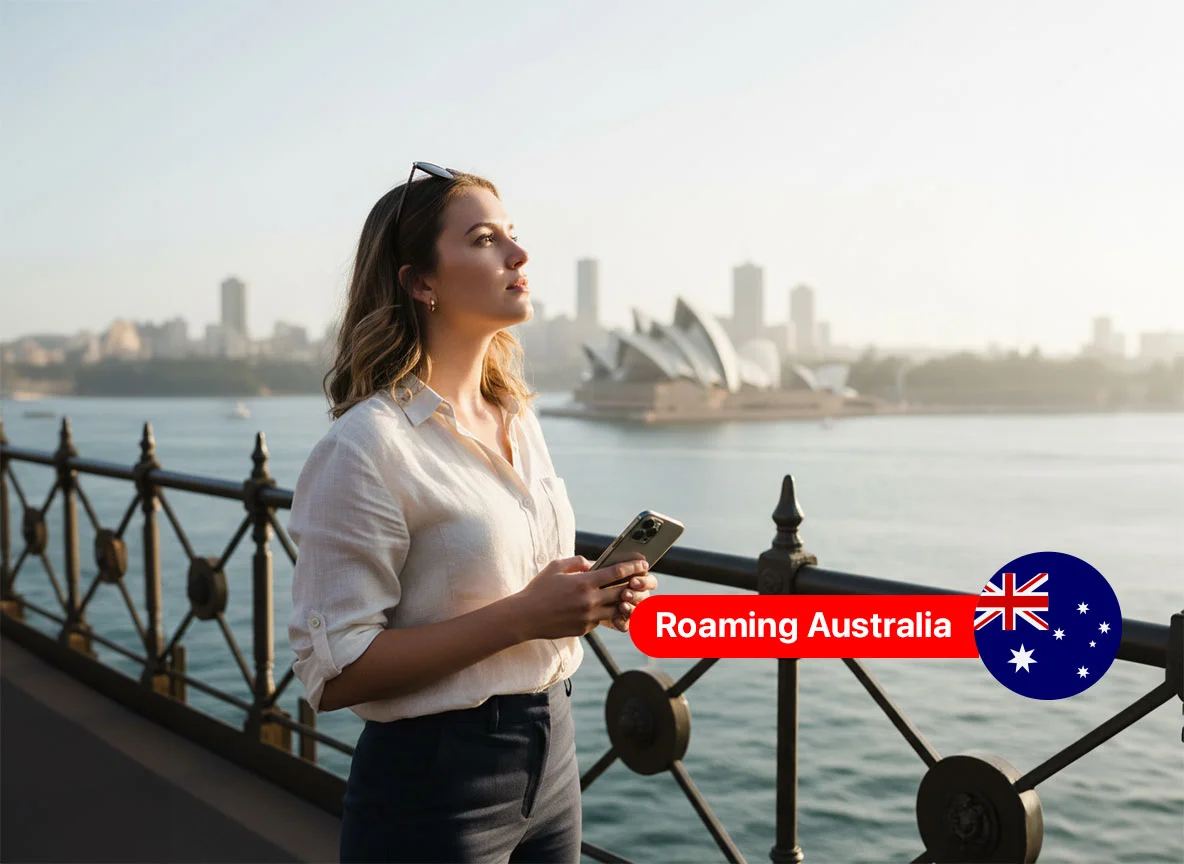
You've booked the flights, sorted the visa waiver, and started a rough itinerary from Sydney to the Great Barrier Reef. Then the question comes up: what do you do about your phone? Roaming in Australia from the US, UK, or Canada sounds straightforward until you read the fine print on your carrier's website and realize that a two-week trip could easily add $150 or more to your next bill. This guide breaks down exactly what the major carriers charge, when those costs make sense, and when a travel eSIM is the smarter move. Australia has excellent 4G LTE and growing 5G coverage in its cities, so connectivity itself isn't the problem. The billing is.
The three largest US carriers, T-Mobile, AT&T, and Verizon, all cover Australia. What varies sharply is the cost structure and what you actually get for your money.
T-Mobile is the most internationally friendly of the three. Customers on Go5G Plus, Go5G Next, or similar premium unlimited plans get basic international data included at 256 Kbps speeds, which is enough for messaging and maps but frustratingly slow for anything else. For usable speeds, T-Mobile sells time-limited passes: a one-day International Pass for around $5 covering 512 MB, a 10-day pass for roughly $35 covering 5 GB, or a 30-day pass for $50 with 15 GB. Without a pass, pay-per-use rates apply at $0.25 per minute for calls and $0.01 per MB for data.
AT&T and Verizon follow a similar daily-pass model. Both offer an International Day Pass at $12 per day, charged only on days you actually use your phone abroad. That sounds reasonable for a short trip, but a 14-day visit to Australia comes to $168 in day-pass fees alone, before your regular monthly bill. Without a day pass activated, both carriers fall back to pay-per-use rates of $2.05 per MB, which equals roughly $2,050 per gigabyte. A single hour of Google Maps navigation can cost more than your airport transfer. Always confirm that a day pass is active before you land.
Verizon also offers monthly international plans starting around $100 per month for 210+ destinations including Australia, with a 20 GB high-speed cap before speeds slow to 3G. This can make sense for frequent travelers or anyone spending more than 10 days abroad.
Post-Brexit, UK carriers have moved away from the Roam Like at Home rules that applied across the EU. For Australia specifically, this means every major network has its own approach, and Australia is generally treated as a long-haul destination with higher daily charges than Europe.
EE offers its Roam Abroad Pass at £25 per month, which covers the US, Canada, Mexico, Australia, and New Zealand alongside European destinations. If you are already paying this monthly add-on, using your phone in Australia costs nothing extra. Without the pass, EE charges per-destination rates for non-EU countries, with Australia typically falling into a zone priced at around £6.27 to £7.84 per day depending on your plan. EE does not offer pay-as-you-go data rates for Australia, so the pass is effectively your only practical option if you are an EE customer traveling there.
O2 covers Australia within its Travel Bolt On, priced at £7 per day. This gives you access to your UK plan allowances in 75 destinations including Australia. O2 customers on the Ultimate plan can add the Travel Inclusive Zone Bolt On to use their allowances without that daily charge. Without any bolt-on, O2 charges £7.20 per MB for data in Australia, £3 per voice minute, and £1 per text. Those pay-as-you-go rates are genuinely eye-watering and should be treated as a fallback of last resort.
Three UK is arguably the most generous for long-haul travelers. On Three's Complete plans, Australia is included within the Go Roam Around the World programme covering 71 destinations, with a 12 GB fair-use cap per month. On Value plans, a day charge applies. Without a Go Roam-eligible plan, Three charges £7 per day for Australia. Pay-as-you-go rates without any pass stand at 10p per MB, 35p per text, and £1.40 per minute.
Vodafone UK's roaming in Australia depends heavily on which plan you're on. The Unlimited Max Global Roam plan includes Australia with up to 25 GB of your UK allowance usable abroad. On a standard Basics plan, a roaming pass costs around £7.86 per day. Without a pass, Vodafone charges 12p per MB, 8p per text, and 36p per voice minute.
Canada's big three, Rogers, Bell, and Telus, all treat Australia as an international destination covered by their respective day-rate roaming products.
Rogers offers Roam Like Home at CAD $16 per day in international destinations including Australia. For longer trips, Rogers introduced Travel Passes: a 14-day pass for CAD $100 and a 30-day pass for CAD $110. These are substantially better value than daily rates for stays of more than a week, since 14 days at the daily rate would otherwise cost CAD $224.
Bell's Roam Better service covers Australia at CAD $16 per day in international destinations. Bell does not offer a separate multi-day pass for Australia specifically, though its Roam Better plan covers 200+ destinations and activates automatically when you use your device abroad. Without Roam Better, Bell's pay-per-use rates apply at CAD $8 to $16 per MB for data and CAD $2.50 to $4 per minute for calls.
Telus raised its Easy Roam rates in October 2025. International destinations including Australia now cost CAD $18 per day, up from CAD $16. Telus also offers regional travel passes (Europe, Asia, etc.) but Australia falls outside those zones, meaning daily Easy Roam is the standard option for most customers. The premium 5G+ Complete Explore plan includes roaming in 68 destinations, though Australia's inclusion in that specific list should be confirmed with Telus directly before travel. Without any pass, Telus pay-per-use rates for international data reach CAD $5 per MB.
Activate your pass before boarding. Day passes and roaming add-ons should be set up before you leave. With AT&T and Verizon, the day pass triggers automatically the first time you use data abroad, but confirming it's active in your account settings prevents surprises if the automatic trigger misfires.
Watch your data cap closely. Verizon's TravelPass, Three's Go Roam, and Vodafone's global plans all impose speed caps once you hit your high-speed allowance. Streaming video in a Sydney Airbnb will burn through a 5 GB cap in an afternoon. Download offline maps and playlists before you fly.
Australian networks are carrier-agnostic for roaming. Your home carrier connects you to a local Australian network through a roaming agreement, typically Telstra or Optus. You generally cannot choose which local network you land on, and rural coverage in Australia can vary significantly. The Outback, Kimberley, and remote Queensland have real coverage gaps regardless of which carrier's roaming badge you carry.
Dual-SIM devices give you a fallback. Most modern iPhones and Android flagships support Dual SIM or eSIM alongside a physical SIM. This means you can install a local Australian data eSIM while keeping your home SIM active for calls, texts, and banking OTPs. You stay reachable on your regular number at no roaming cost.
Disable background app refresh before landing. Cloud backups, email sync, and app updates can silently consume hundreds of MB without you touching your phone. On iOS, turn off Background App Refresh for all apps under Settings before you switch to a roaming plan. On Android, restrict background data in the mobile data settings.
Check the fair-use policy on unlimited plans. Three UK and Vodafone UK both call their roaming data unlimited but cap high-speed data in Australia at 12 GB and 25 GB respectively. Going over these limits does not cut your connection, but speeds drop sharply. For a two-week trip with normal usage, 12 GB is usually enough. For remote work, video calls, or heavy streaming, it may not be.
Carrier roaming has genuine advantages: one bill, no extra setup, and your number works exactly as it does at home. For a quick 5-day trip where you mainly need maps and the odd WhatsApp message, a $12/day pass or a £7/day bolt-on is perfectly reasonable. The math changes on longer trips.
A Canadian Rogers customer spending 14 days in Australia pays CAD $224 at the daily rate, or CAD $100 with the Rogers 14-day Travel Pass. That's still a significant add-on cost. A US Verizon customer on a 14-day trip pays $168 in TravelPass fees. For a UK traveler on EE without the Roam Abroad Pass, the per-day rate for 14 days adds up to roughly £90-110.
A prepaid travel eSIM covers Australia with local Telstra or Optus network access at a fraction of those costs, typically for a flat fee tied to your trip duration. There's no risk of accidentally racking up charges the moment you land, no speed throttling after a data cap, and you keep your home SIM active in the second slot for calls and verification codes. For trips of a week or more, the savings are typically substantial.
Australia is not a quick city break. The distances are enormous. Sydney to the Whitsundays is a 2-hour flight. Melbourne to Uluru is longer than London to Istanbul. Travelers typically stay for two weeks or more, which is exactly the window where daily roaming fees become genuinely painful and a flat-rate prepaid plan starts making obvious financial sense.
TurkSIM connects to Telstra and Optus in Australia, the same two networks that domestic carriers roam onto. That means you get real local network performance in Sydney, Melbourne, Brisbane, and Perth, not a degraded international roaming tier. In practice, this matters most for video calls, uploading photos from the field, and using navigation in areas where signal is precious.
The Dual SIM advantage is particularly relevant for visitors whose banks and employers send OTP codes to their home number. With a TurkSIM eSIM installed in your second profile, your original SIM stays live in the background, accepting calls and verification messages, while the eSIM handles all data. You do not need to choose between local data rates and staying reachable on your regular number.
There is no physical SIM to collect at the airport, no registration process requiring a local ID, and no waiting in a Telstra store after a 22-hour flight. The eSIM Australia arrives by email as a QR code, installs in under five minutes, and sits ready to activate the moment you land. For backpackers moving between Melbourne, Adelaide, and Alice Springs, for corporate travelers jumping between Sydney and Brisbane, or for families sharing a hotspot across multiple devices, that simplicity matters.
Most carriers recommend confirming international roaming is enabled on your account before departure, even if it should be on by default. AT&T, Verizon, Rogers, Bell, and Telus all allow you to verify this in their apps. It takes 30 seconds and prevents the frustrating scenario of landing in Sydney and finding your phone stuck in SOS-only mode.
Australia uses the same major LTE bands (B1, B3, B28) found on most modern unlocked smartphones from Apple, Samsung, and Google. Phones purchased outright or paid off through your carrier should work without issue. Carrier-locked phones may be restricted from connecting to Australian networks, so check your device's lock status before you travel.
This depends on your plan. Most UK carriers (Three, Vodafone, EE) throttle speeds heavily after hitting the fair-use cap, typically to 2G or low 3G, rather than cutting your connection entirely. US and Canadian carriers generally either continue at full speed (billed per MB at high PAYG rates) or throttle to 3G once the high-speed allowance is used. Always read the overage clause for your specific plan before you travel.
Major cities and popular tourist routes along the East Coast, including the Great Ocean Road and the Pacific Highway, have reliable 4G coverage. The further you go inland, the patchier coverage becomes. The Outback, Kakadu, and Cape York Peninsula have significant coverage gaps on all networks including Telstra's domestic network. Satellite-based connectivity options are separate from any mobile plan and not covered by standard roaming agreements.
Technically yes on most plans, but fair-use policies often restrict or deprioritize hotspot traffic. Verizon's TravelPass allows hotspot use but counts against the same high-speed data pool. Three UK's Go Roam does not explicitly prohibit hotspot use within the 12 GB cap. A TurkSIM eSIM allows unlimited hotspot sharing with no policy restrictions.
A local physical SIM from Telstra, Optus, or Woolworths Mobile is another solid option if you arrive at a major airport and have time to stop at a store. Prices are competitive and coverage is local-grade. The trade-off is that you swap out your home SIM, losing your regular number for incoming calls during that period. An eSIM installs alongside your existing SIM, so you get local data rates and keep your home number active simultaneously.
Traveling to another country? Find roaming information for other destinations here: