Disclaimer: The prices and information presented on this page reflect a snapshot at the time of research and may change at any time without prior notice.

Liam
27 March 2026


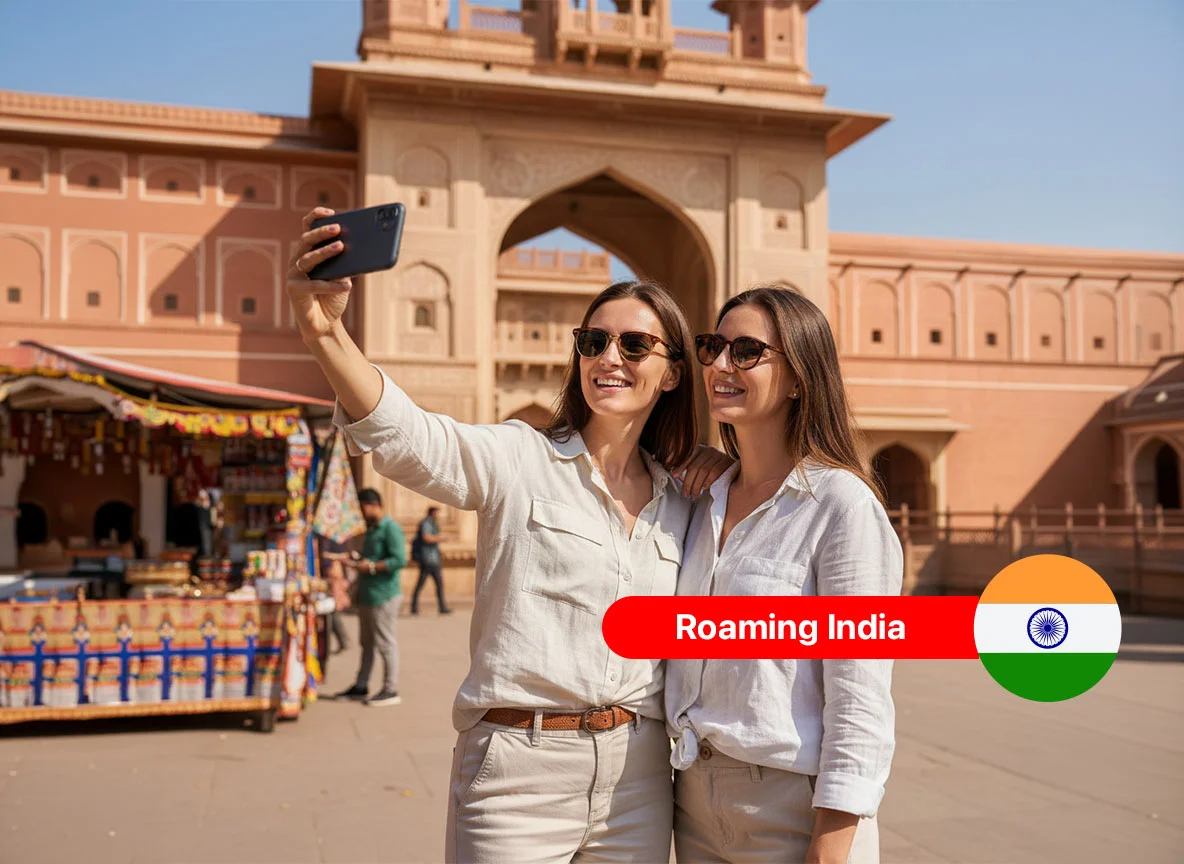
India is a country of contrasts when it comes to mobile connectivity. In Delhi and Mumbai, 4G coverage is fast and reliable. In rural Rajasthan or the hills of Himachal Pradesh, signal can drop to 2G or disappear entirely. For international visitors, the challenge is not just coverage but cost. Roaming in India with a US, UK, or Australian carrier means paying premium rates for data that may not even work consistently across the subcontinent. AT&T and Verizon charge $12 per day. Vodafone UK charges £6–£7.86/day. Without a day pass, per-megabyte costs can reach $2–15 depending on your carrier. And India adds another wrinkle: the country has strict telecom regulations that sometimes complicate roaming connections. This guide explains what roaming in India costs, which carriers perform best, and why a travel eSIM is often the smarter choice for visitors navigating this vast and varied country.
India has two dominant mobile carriers: Jio (the largest by subscriber count, known for aggressive pricing and strong 4G coverage) and Airtel (the second largest, with reliable coverage in both cities and many rural areas). Vodafone Idea (Vi) is the third carrier, though its network quality and financial stability have been inconsistent. BSNL, the state-owned carrier, covers some areas where private networks do not reach, particularly in remote regions and border areas.
When you arrive in India with an international SIM, your phone connects to one of these networks through your home carrier’s roaming agreement. The connection is usually to Airtel or Vodafone Idea, as these carriers have the most international roaming partnerships. Jio’s roaming partnerships with foreign carriers are more limited, which means you may not always land on the fastest available network.
India’s telecom regulator (TRAI) enforces strict rules that affect international visitors. Buying a local Indian SIM card requires in-person identity verification with a valid passport and visa, plus an address proof (typically a hotel booking). The activation can take 24–48 hours due to verification requirements. This makes a quick SIM swap at the airport impractical for short-term visitors, which is one reason why eSIMs have become popular for India travel.
Disable data roaming before landing. India’s airports have free Wi-Fi (with OTP verification via an Indian number, which creates a catch-22 for visitors). Turn off your home SIM’s data roaming and rely on your travel eSIM or hotel Wi-Fi initially.
Understand India’s SIM card rules. Getting a local Indian SIM requires your passport, visa, a passport-sized photo, and address proof. Activation takes 24–48 hours. For short trips (under two weeks), this process is often not worth the effort. An eSIM sidesteps all of these requirements.
Download offline maps for your route. India’s cities are complex to navigate, and rural areas may have spotty coverage. Download Google Maps for Delhi, Jaipur, Goa, Kerala, or whichever regions you plan to visit. GPS works without data.
Expect variable speeds outside cities. India’s 4G network is fast in major metros (Delhi, Mumbai, Bangalore, Hyderabad) but can slow dramatically in smaller towns and rural areas. Adjust your data expectations if travelling to places like Ladakh, the Northeast states, or remote parts of Rajasthan.
Use WhatsApp for everything. WhatsApp is India’s default communication app. Restaurants, tour operators, taxi drivers, and hotels all communicate via WhatsApp. Having mobile data for WhatsApp is practically essential for daily interactions.
Be aware of regional network differences. Indian carriers operate on a circle-based system, meaning network performance can vary between states. Airtel might be excellent in Maharashtra but weaker in the Northeast. A travel eSIM with access to multiple carriers helps smooth out these regional differences.
India is one of the countries where a travel eSIM makes the most compelling case. The local SIM activation process is slow and bureaucratic. Carrier roaming is expensive. And the country’s sheer size means you need data almost constantly for navigation, translations, and communication.
A travel eSIM skips the 24–48 hour local SIM activation wait. You purchase it before your trip, install it via QR code, and activate it when you land. Your data runs on Indian networks (typically Airtel and Vodafone) at 4G/LTE speeds. No passport photos, no address proof, no waiting period.
For travellers combining India with other Asian destinations (a common itinerary includes India and Sri Lanka, or India and Nepal), separate eSIM plans for each country keep you connected without managing multiple physical SIMs or tracking different roaming rates.
India demands connectivity at every turn. Hailing an auto-rickshaw through Ola or Uber in Bangalore. Checking train status on the IRCTC app. Translating Hindi menus in a Varanasi street stall. Finding your way through Old Delhi’s labyrinthine lanes. Each of these moments requires data, and each is infinitely easier with a reliable, affordable connection.
TurkSIM’s eSIM for India connects to Airtel, BSNL, and Vodafone, giving your phone access to networks that cover the vast majority of the country. Airtel’s network is particularly strong in major cities and along national highways. BSNL fills gaps in remote and government-controlled areas. Together, they provide coverage that a single roaming partner often cannot match.
The financial advantage is clear. Two weeks of AT&T roaming at $12/day costs $168. The same period with a TurkSIM eSIM data package costs a fraction of that. For backpackers on a longer India itinerary (the classic Delhi–Agra–Jaipur Golden Triangle, then down to Goa and Kerala), the savings over weeks of roaming are substantial.
With dual SIM, your home number stays active. Receive banking OTPs, WhatsApp messages from home, and emergency calls on your regular number. All data flows through the Indian network on your eSIM. No roaming charges from your home carrier, no bill shock when you return.
US carriers charge $12/day with a day pass or $2.05/MB without one. UK carriers charge £5–£7.86/day. Australian carriers charge AUD $5–10/day. Without any add-on, even checking email or using maps becomes very expensive.
Yes, but it requires your passport, visa, a passport photo, and address proof (such as a hotel booking). Activation takes 24–48 hours. For short visits, the process is often not worth the wait. A travel eSIM activates instantly without any paperwork.
4G/LTE coverage is excellent in major cities and along main transport corridors. In rural areas, smaller towns, and mountainous regions (Ladakh, Northeast India, parts of Rajasthan), coverage may drop to 3G or 2G. Network performance also varies between carriers and states.
T-Mobile includes India in some higher-tier plans. Most other US, UK, and Australian carriers require a day pass or charge per-use rates. Always check your specific plan before travelling.
Yes. WhatsApp works over any data connection, including a travel eSIM. Your WhatsApp account stays linked to your home number. You just need mobile data or Wi-Fi for it to function.
Coverage depends on the local network. In well-connected states (Maharashtra, Karnataka, Tamil Nadu, Delhi NCR), coverage is excellent. In remote areas, coverage may be limited regardless of whether you use roaming or an eSIM. Airtel and BSNL typically have the widest reach.
Yes. With a dual-SIM phone, keep your home SIM active for calls and texts while using the TurkSIM eSIM for data. This is especially important for receiving banking verification codes sent via SMS.
Planning a trip across Asia? Find more guides: