Disclaimer: The prices and information presented on this page reflect a snapshot at the time of research and may change at any time without prior notice.

Liam
27 March 2026


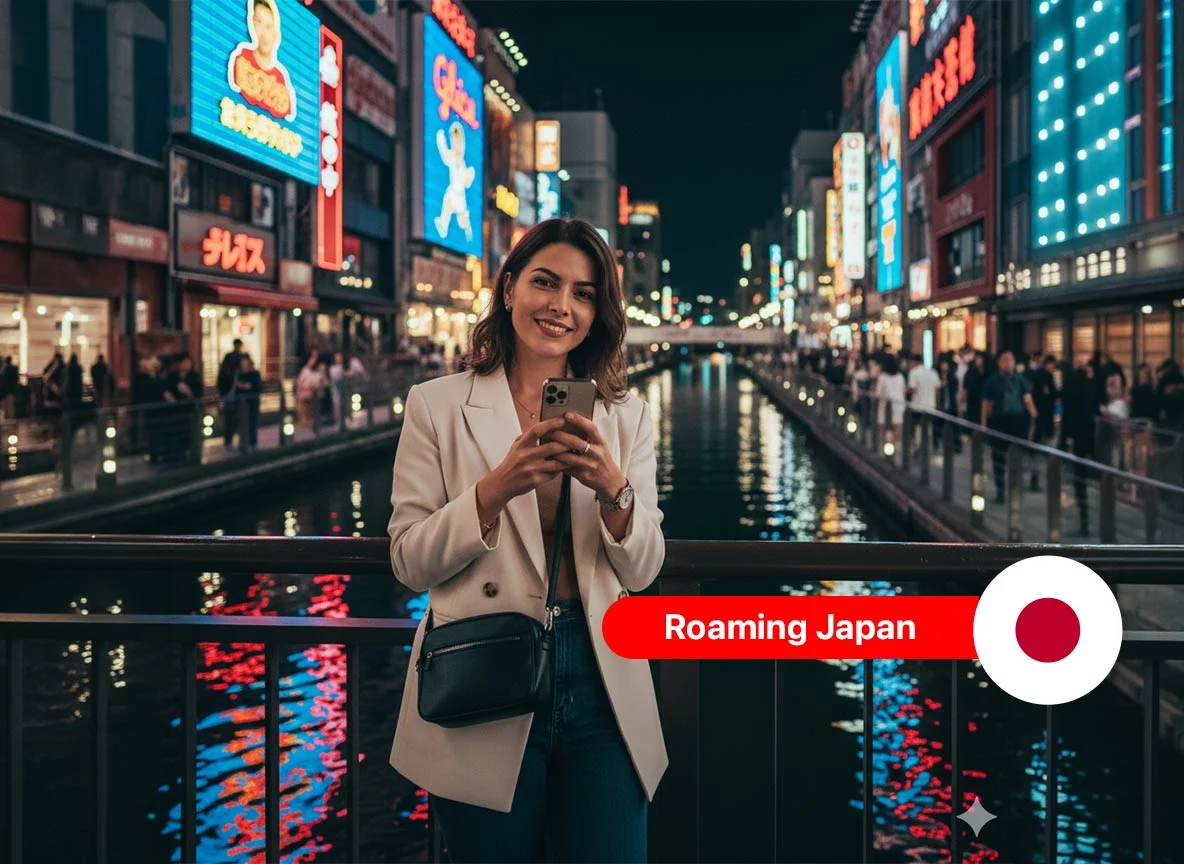
Japan is a destination where your phone becomes your most valuable travel tool the moment you step off the plane at Narita or Haneda. Navigating Tokyo’s sprawling train network, finding the right platform at Shinjuku Station (the world’s busiest), reading a menu at a ramen shop in Osaka, checking cherry blossom forecasts in Kyoto, or booking a last-minute ryokan in Hakone. Every one of these moments requires data. For international visitors, roaming in Japan is expensive regardless of where you are travelling from. US carriers charge $12/day. UK carriers charge £5–£7.86/day. Australian carriers charge AUD $5–10/day. Without a day pass, per-megabyte charges make even basic phone use prohibitively costly. This guide covers what visitors from the US, UK, Canada, Australia, and Europe actually pay for roaming in Japan, how the local networks work, and why a travel eSIM has become the go-to solution for Japan-bound travellers.
Japan has three main mobile carriers: NTT Docomo (the largest, with the widest nationwide coverage including rural areas and mountain regions), au by KDDI (strong coverage, competitive with Docomo), and SoftBank (good urban coverage, growing rural reach). All three offer comprehensive 4G/LTE and expanding 5G in major cities. Japan’s mobile infrastructure is among the best in the world.
When you arrive with an international SIM, your phone connects to one of these networks through your home carrier’s roaming agreement. Most international carriers partner with NTT Docomo or SoftBank for Japan roaming. Japan is classified as "Asia-Pacific" or "Rest of World" by most carriers, placing it in a higher-cost roaming tier.
Japan does not have the strict SIM registration rules that countries like India or Turkey enforce. However, buying a local Japanese SIM card at the airport requires an unlocked phone, and plans are typically data-only (no voice calls on tourist SIMs). This makes eSIMs an especially practical alternative, as they offer the same data-only functionality without the need to visit a shop.
Japan’s train apps are essential and data-hungry. Google Maps, Navitime, and Japan Transit Planner are indispensable for navigating Japan’s complex rail system. These apps need data to calculate routes, check delays, and show platform numbers. Download them and test before your trip.
Download offline maps for rural areas. Japan’s cities have excellent coverage, but mountain areas (Japanese Alps, rural Hokkaido, Shikoku interior) can have gaps. Download Google Maps for any regions outside major urban centres.
Free Wi-Fi in Japan has improved but remains spotty. Major stations, airports, and some convenience stores (7-Eleven, Lawson, FamilyMart) offer free Wi-Fi, but connection often requires registration and sessions are time-limited. For reliable, constant connectivity, mobile data is the only practical solution.
Japan’s tourist SIMs are data-only. If you buy a local SIM at Narita, Haneda, or Kansai Airport, it will be data-only. No voice calls are included (regulatory restriction). This means a local SIM and a travel eSIM offer essentially the same functionality, but the eSIM skips the airport queue.
IC cards and QR payments need connectivity. Japan’s Suica and PASMO transit cards can be added to Apple Wallet (which works offline), but loading them and checking balances requires data. Many restaurants and shops also use QR-code payment systems that need connectivity.
Consider a pocket Wi-Fi only for groups. Japan is one of the few countries where pocket Wi-Fi rental is still popular. It makes sense for families or groups sharing a single connection. For solo travellers or couples, an eSIM is lighter, cheaper, and always with you.
Japan is one of the destinations where a travel eSIM makes the strongest case. Carrier roaming is expensive across the board. Local tourist SIMs are data-only anyway (same as an eSIM). And Japan’s reliance on transit apps, maps, and translation tools makes constant data access practically mandatory.
A two-week trip with AT&T at $12/day costs $168. With Vodafone UK at £7.86/day, it is £110. Even Telstra’s relatively affordable AUD $5/day adds up to AUD $70. A TurkSIM eSIM data package for the same period costs a fraction of those amounts.
For travellers combining Japan with South Korea (a common route: Tokyo, then Seoul via a short flight), separate eSIM plans avoid the hassle of tracking carrier zone changes across the Sea of Japan.
Japan is a country that runs on precision, and your phone helps you match that precision. Catching the 14:23 Shinkansen from Tokyo to Kyoto (not the 14:26, which goes to Nagoya). Finding the specific exit at Shibuya Station that leads to Hachiko. Checking whether the teamLab exhibit requires advance booking. Translating the kaiseki menu at a traditional Kyoto restaurant. Each of these moments works better with reliable, affordable data.
TurkSIM’s Japan eSIM connects to NTT Docomo, the network with the widest coverage in Japan. From downtown Tokyo to rural Tohoku, from Osaka’s Dotonbori to the temples of Nara, Docomo’s infrastructure ensures consistent connectivity. The Shinkansen corridors, including tunnels, have excellent coverage on Docomo’s network.
The savings compared to roaming speak for themselves. Two weeks of AT&T roaming costs $168. A TurkSIM data package for the same period costs a fraction of that. For Australian visitors on Telstra at AUD $5/day, the savings are smaller but still meaningful on longer trips.
Dual SIM keeps your home number active. Receive banking OTPs, WhatsApp messages, and calls on your regular number. All data flows through NTT Docomo’s network via your eSIM. No roaming charges from your home carrier, no bill surprises.
US carriers charge $12/day. UK carriers charge £5–£7.86/day. Australian carriers charge AUD $5–10/day. Canadian carriers charge CA$14–16/day. Without a pass, per-megabyte rates are very expensive.
Yes. Data-only SIM cards are available at Narita, Haneda, and Kansai airports. They are data-only (no voice calls) due to Japanese regulations. An eSIM offers the same data-only functionality without queuing at the airport.
Excellent. Japan’s 4G/LTE coverage is among the best in the world. Cities, highways, and even many mountain areas have strong signal. 5G is available in major urban centres. Only the most remote mountain areas and some island locations have gaps.
Japanese regulations restrict voice services on short-term SIM cards for tourists. This applies to both physical SIMs and eSIMs. Use apps like WhatsApp, LINE, or FaceTime for voice and video calls over data.
Free Wi-Fi exists at airports, major stations, and convenience stores, but requires registration and has time limits. For navigation, transit apps, and constant communication, mobile data is essential. Japan’s complex train system alone makes always-on data practically mandatory.
Yes. Dual-SIM phones let you keep your home SIM for calls and texts while the eSIM handles data. You stay reachable and avoid roaming data charges.
Planning a Japan trip? Find carrier-specific guides: