Disclaimer: The prices and information presented on this page reflect a snapshot at the time of research and may change at any time without prior notice.

Liam
27 March 2026


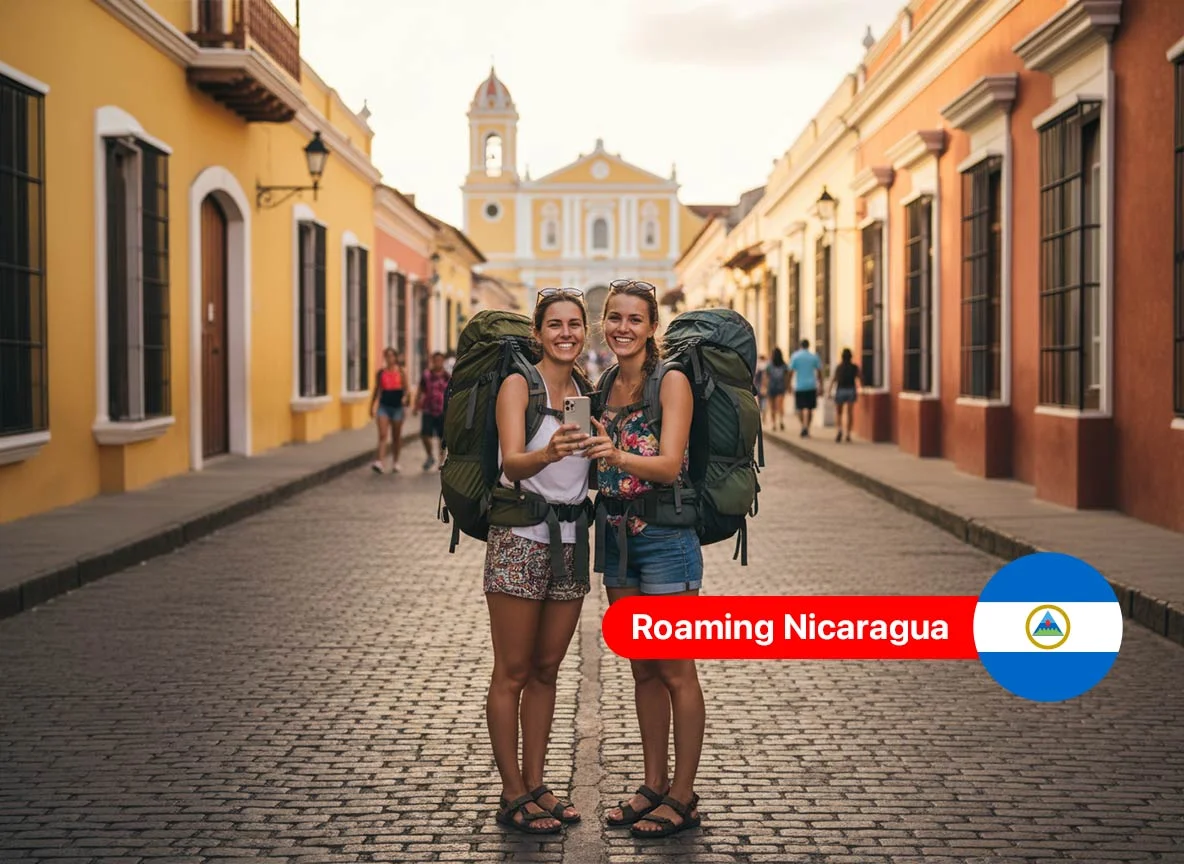
Nicaragua is still under the radar for many travellers, which is exactly what makes it appealing. Volcanic landscapes, colonial cities like Granada and León, surf breaks on the Pacific coast, and the Caribbean island charm of the Corn Islands all come without the crowds. But that off-the-beaten-path quality also means that staying connected requires a bit more planning. Nicaragua is not a destination where your carrier’s roaming just works smoothly and affordably. US carriers charge $12 per day for a roaming pass. European and Australian carriers charge similar or higher daily fees. Without a pass, per-megabyte rates can reach $2 or more, turning a quick maps search into a surprisingly expensive operation. This guide covers what roaming in Nicaragua actually costs, how the local networks work, and why most travellers are better off with a travel eSIM or local SIM card.
Nicaragua has two main mobile carriers: Claro (owned by América Móvil, the market leader with the widest coverage) and Tigo (formerly Movistar, acquired by Millicom, with strong coverage in cities and along highways). A smaller third operator, CooTel (backed by China’s Xinwei), uses non-standard technology and is not relevant for most international visitors.
When you arrive in Nicaragua with a foreign SIM, your phone connects to either Claro or Tigo through your home carrier’s roaming agreement. Both networks provide 4G/LTE coverage in Managua, León, Granada, Esteli, and other major cities. Coverage along the main Pacific coast highway and in popular tourist areas is generally reliable. Rural areas and the Caribbean coast (including the Corn Islands) have more variable coverage, often dropping to 3G or 2G.
Nicaragua is classified as a "Rest of World" or "Latin America" destination by most international carriers. It falls outside any free roaming inclusion for US, UK, or Australian carriers. Some T-Mobile plans include Nicaragua in their 215+ country international data allowance, but at reduced speeds. Most carriers require a separate day pass or charge steep per-use rates.
Buy a local SIM at Managua Airport. Both Claro and Tigo sell prepaid SIM cards at Managua’s Augusto C. Sandino International Airport. A SIM costs about 50 NIO (roughly $1.35 USD) and data packages are very affordable: a few hundred MBs to several GBs for under $5. You may need your passport.
Claro has the widest coverage. If you are travelling beyond Managua and the Pacific corridor, Claro generally has better reach in rural areas. Tigo can have slightly better coverage in some specific regions, but Claro is the safer bet for country-wide travel.
Download offline maps for the entire country. Nicaragua is small enough that you can download the whole country in Google Maps for offline use. This is essential for driving between cities, finding remote surf spots, or navigating towns without street signs.
Expect slower speeds outside cities. 4G/LTE is available in major cities, but rural areas and the Caribbean coast often have 3G or 2G coverage. Plan for slower connections when heading to the Corn Islands, Ometepe, or the northern highlands.
Wi-Fi is available but inconsistent. Hotels, hostels, and some restaurants in tourist areas offer free Wi-Fi. Quality varies significantly. In Granada and San Juan del Sur, hotel Wi-Fi is usually decent. On the Corn Islands or in smaller towns, do not count on it for anything beyond basic messaging.
Top up through mobile apps or shops. If you buy a local Claro or Tigo SIM, top-ups are available at any convenience store, gas station, or through the carrier’s app. The top-up ecosystem is simple and widely accessible.
For trips shorter than a week, an eSIM often makes more sense than hunting for a local SIM shop. You can purchase and install it before you leave, and it activates the moment you land. No passport verification delays, no finding a shop that sells SIM cards, no figuring out how to top up in Spanish.
For longer trips, a local SIM card from Claro or Tigo is incredibly cheap and offers the best rates. But if your phone supports dual SIM, you can use a travel eSIM for data and keep your home SIM for calls and texts. This combination gives you the best of both worlds.
The financial comparison is straightforward. AT&T or Verizon roaming at $12/day for a 10-day trip costs $120. A TurkSIM eSIM data package for the same period costs a fraction of that. Even compared to a local SIM (which is the cheapest option), an eSIM saves you the time and hassle of buying and setting up a physical card.
Nicaragua is a destination where spontaneous travel decisions are part of the experience. A local recommends a hidden waterfall near Matagalpa. Someone at your hostel says the surf is firing at Popoyo. A chicken bus to Ometepe leaves in 20 minutes. Each of these moments works better with data on your phone for maps, schedules, and messaging.
TurkSIM’s Nicaragua eSIM connects to Tigo and Movistar, covering Managua, the Pacific coast, and major cities between. For travellers combining Nicaragua with Costa Rica, Honduras, or other Central American destinations, separate eSIM plans keep you connected at each stop without swapping SIMs or tracking roaming zones.
The dual SIM setup lets you keep your home number active for calls and banking codes while all data runs through the Nicaraguan network on your eSIM. Installation takes minutes before your trip, and activation happens automatically when you land in Managua.
US carriers charge $12/day with a day pass or $2.05/MB without one. UK carriers charge up to £7.86/day. Without any add-on, roaming in Nicaragua is very expensive for any meaningful data usage.
Yes. Claro and Tigo sell prepaid SIM cards at Managua’s international airport. A SIM costs about 50 NIO ($1.35 USD). Data packages are very affordable. You may need to show your passport.
Claro has the widest overall coverage, especially in rural areas. Tigo performs well in cities and along major highways. For country-wide travel, Claro is generally the more reliable option.
4G/LTE is available in Managua, León, Granada, Esteli, and other major cities. Rural areas, the Caribbean coast, and smaller islands often have 3G or 2G coverage. Expect variable speeds outside urban centres.
For short trips (under a week), an eSIM is more convenient: no shop visit, no passport hassle, instant activation. For longer stays, a local SIM is cheaper per GB. If your phone supports dual SIM, you can use both simultaneously.
Yes. With a dual-SIM phone, your home SIM stays active for calls and texts while the eSIM handles data. This means you can receive messages and calls on your regular number without paying roaming data charges.
T-Mobile includes Nicaragua in its 215+ country international data allowance on some plans (Experience Beyond and similar). However, data speeds may be reduced compared to your home network. Check your specific plan for details on high-speed data allocation.
Planning a Central America trip? Find more guides: