Disclaimer: The prices and information presented on this page reflect a snapshot at the time of research and may change at any time without prior notice.

Liam
07 May 2026


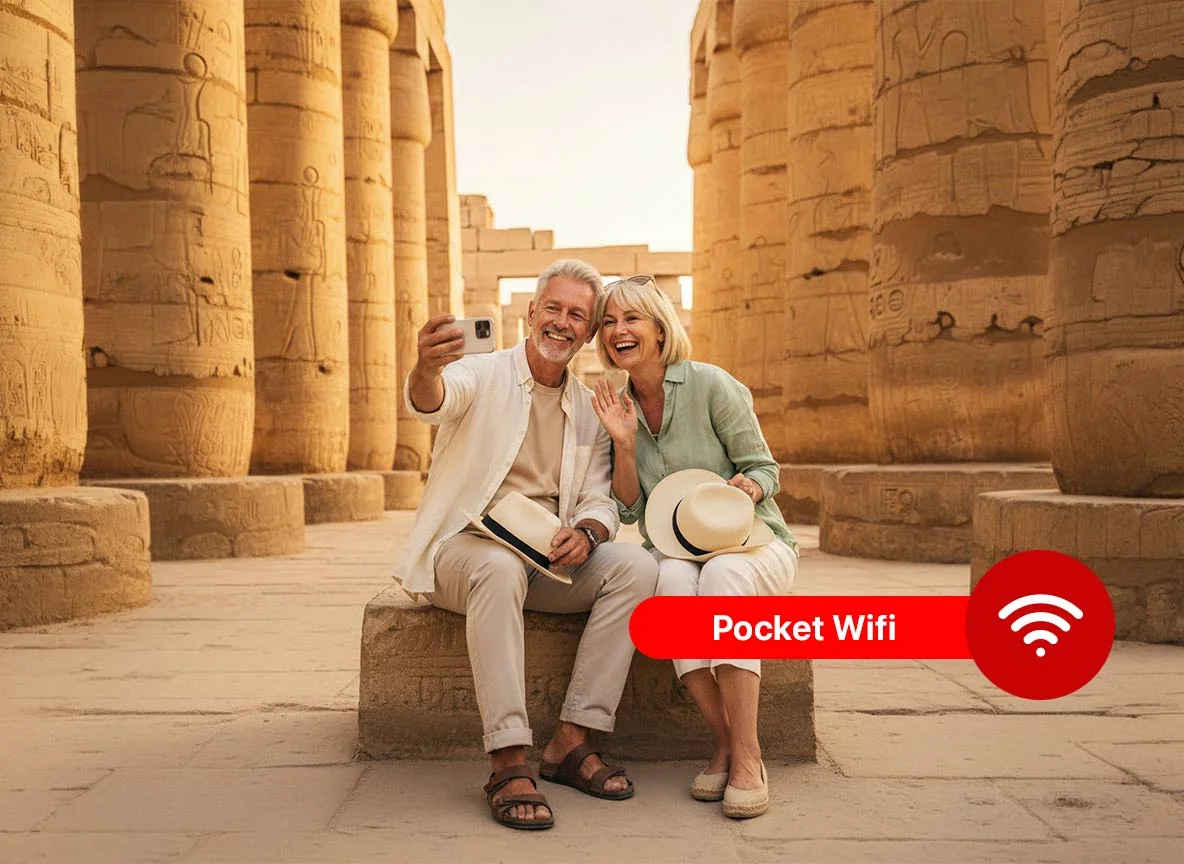
You step out of Cairo International Airport's Terminal 3 into the late-afternoon desert heat, the air thick with diesel fumes and the call of prayer drifting from a nearby mosque. Phone in hand, you check the Uber to your hotel near Tahrir Square. Vodafone UK Global Roam already charged GBP 6 for the day, the Egypt-zone surcharge that runs alongside the same daily-pass rates Telekom Deutschland and Orange France apply to non-EU destinations. The 13 million inbound tourists who flew into Cairo, Sharm el-Sheikh, Hurghada, or Luxor in 2025 face the same arithmetic at touchdown: home-carrier daily pass, Egyptian Pocket WiFi rental, or travel eSIM. The catch is the Egyptian SIM-registration rule, which adds a 30-minute paperwork stop with passport ID at any Vodafone Egypt, Orange Egypt, or WE store before a tourist SIM activates.
Pocket WiFi in Egypt is a portable LTE or 5G hotspot rented for the trip. The device holds an Egyptian data SIM and broadcasts a private WiFi network for the traveller's phones, tablets, and laptops. Four carriers anchor the rental fleet: Vodafone Egypt, Orange Egypt, Etisalat Egypt (now operating under the e& umbrella), and WE (Telecom Egypt's mobile arm). Vodafone Egypt holds the strongest urban 4G LTE in Cairo, Alexandria, and Luxor, plus consistent coverage along the Nile cruise corridor from Aswan to Esna. Orange Egypt runs the deepest national footprint, with the most reliable signal in the Western Desert oases of Siwa, Bahariya, and Farafra, and along the Sinai peninsula highways from Sharm el-Sheikh to St. Catherine. Etisalat covers the Red Sea resorts of Hurghada and Marsa Alam well, while WE focuses on Cairo and the Nile Delta cities.
5G has been live in Cairo, Giza, and Alexandria since 2023, with peak speeds approaching 700 Mbps in central business districts. The Red Sea resort areas, the Luxor and Aswan tourist zones, and the Sharm el-Sheikh strip run on consistent 4G LTE. Coverage thins fast in the Western Desert beyond Bahariya, in the deeper Eastern Desert mountains, and on the smaller Red Sea diving islands. Most rental fleets in Egypt ship with Vodafone Egypt or Orange Egypt as the primary network because of the carriers' broader nationwide reach.
Battery life on Egyptian rentals runs 8 to 12 hours, lower than Mediterranean fleet averages because of the heat-dissipation challenge in summer when ambient temperatures exceed 40 degrees Celsius. Most rentals support 5 to 8 connected devices, suitable for a Nile cruise group or a Red Sea family.
Egypt has no major dedicated Pocket WiFi rental brand of its own; the inbound rental market is split between European import fleets and a small number of Egyptian tour operators who add WiFi rental as a side service. Daily rates sit at USD 5 to 12 across the mainstream tier, with weekly bundles undercutting daily rates by 20 to 35%. Cairo International (CAI) hosts the only consistent airport-counter rental option; Hurghada (HRG), Sharm el-Sheikh (SSH), Luxor (LXR), and Aswan (ASW) rely on hotel delivery.
Emo Tours Egypt at roughly USD 5.80 a day is the local tour-operator option with hotel delivery to Cairo, Hurghada, and Luxor. XOXO WiFi at EUR 4.50 is the European budget benchmark. Travel WiFi remains the only consistent airport-counter pickup at Cairo International. MyWebSpot and Tep Wireless tilt toward multi-country itineraries, with the same unit covering Egypt plus Israel and Jordan on a single rental, useful for travellers continuing onto Petra or Tel Aviv after the Nile cruise.
Hotel delivery dominates; Cairo International Airport is the only consistent counter-pickup hub. XOXO WiFi, Emo Tours Egypt, MyWebSpot, and Rent 'n Connect all default to courier or tour-operator delivery 1-2 days before arrival, to a Cairo, Hurghada, Luxor, or Sharm el-Sheikh hotel. Travel WiFi is the only mainstream provider with an airport counter at Cairo International (CAI). Hurghada, Sharm el-Sheikh, Luxor, and Aswan rely on hotel delivery.
The Egyptian airport map runs across five major hubs. Cairo International (CAI) anchors long-haul international arrivals from Europe, the Americas, and Asia. Hurghada (HRG) and Marsa Alam (RMF) handle the Red Sea diving and resort traffic. Sharm el-Sheikh (SSH) covers the Sinai resort area. Luxor (LXR) and Aswan (ASW) anchor the Nile cruise inbound, with most arrivals routed through Cairo or Hurghada first.
Pre-book at least 48 hours before the flight. Walk-up rentals at the Travel WiFi CAI counter are limited and run a 15 to 25% premium. The cheaper unlimited-data units sell out during the October-April peak season for Nile cruises and during the diving-charter weeks of June through September on the Red Sea.
Expect a USD 100 to USD 200 credit card hold. The damage and loss deposit is released on safe return. Lost or damaged units run a charge of USD 200 to 350 depending on the provider. Optional damage insurance for USD 1 to 2 a day caps the worst-case charge.
Nile-cruise coverage holds for the major stops but thins between them. Vodafone Egypt and Orange Egypt cover Aswan, Kom Ombo, Edfu, Esna, and Luxor consistently. The longer overnight stretches between stops, especially on the Aswan-Abu Simbel detour and the Lake Nasser cruises, drop to 3G or no signal at all. Travellers on Nile cruises should download offline maps and accept brief offline stretches between port calls.
The first decision point in Egypt is the local SIM friction. Egyptian law requires every prepaid SIM to be registered with passport ID at the point of sale, with the carrier scanning and storing a passport copy. Cairo Airport Terminal 1, 2, and 3 all host Vodafone Egypt, Orange Egypt, Etisalat, and WE kiosks where the registration takes 15 to 30 minutes. The friction adds up across multiple travellers in the same group. Pocket WiFi rentals and visitor eSIMs both bypass the requirement: the rental SIM is registered to the rental company under a corporate account, and the visitor eSIM ships under a separate enterprise classification.
For solo travellers and couples on eSIM-capable phones, the eSIM route undercuts Pocket WiFi on cost and convenience. A 7-day Egypt eSIM at USD 5 to 15 covers the typical Cairo-Luxor-Aswan-Hurghada sequence, against USD 35 to 84 for the same week of Pocket WiFi rental plus the deposit hold. The eSIM also activates on landing, before the traveller has reached the rental counter.
Pocket WiFi keeps its edge for groups of three or more sharing one device on a 14-day Egypt loop, for travellers without an eSIM-compatible phone, and for itineraries that include Israel and Jordan border crossings where regional fleets like MyWebSpot and Tep Wireless cover all three countries on a single unit.
The trade-offs sharpen for solo travellers and Nile-cruise itineraries. The rental adds a deposit, a hotel-delivery window, and a return cycle.
A TurkSIM Egypt eSIM connects to the Vodafone Egypt and Orange Egypt backbone, the same networks that anchor most local Pocket WiFi fleets. Coverage on the Cairo Metro lines 1, 2, and 3, the Cairo-Alexandria desert highway, the Nile Valley Cruise corridor from Aswan to Luxor, the Sharm el-Sheikh-Dahab coastal road, and the Hurghada-El Gouna resort strip is identical to the rental experience. The difference is what the traveller carries: an eSIM profile lives on the phone alongside the home line, so a UK or German SIM stays reachable for bank verification SMS while data flows over the Egyptian profile.
The cost gap is sharpest for short trips and solo travellers. A 4-day Cairo city stop with Emo Tours Egypt at USD 5.80 a day plus the USD 100 deposit hold runs to USD 23 in real outlay before the deposit clears. The same trip on an Egypt eSIM lands at USD 5 to 9 with no card hold. For a 14-day Cairo-Nile-Cruise-Hurghada loop, even Emo Tours' discounted weekly rate adds to USD 35 to 50 against an eSIM at USD 12 to 25. UK travellers replacing a Vodafone UK Global Roam Plus pass save 60 to 80% on the eSIM route.
Compatibility is the gating question. Most modern phones support eSIM, including the iPhone, recent Samsung Galaxy and Google Pixel models, and most Android flagships from 2022 onwards. The full list lives on the eSIM compatible devices reference, and installation takes five minutes via the standard how to install eSIM walkthrough. Travellers carrying older Android phones, shared-use group hardware on a multi-family Nile cruise, or itineraries with extensive Western Desert oasis time still benefit from a Vodafone-Egypt-anchored Pocket WiFi rental. Everyone else on a city-only or Nile-cruise trip has a softer route to Egyptian data than queuing at a Cairo Airport SIM kiosk.
No. Egyptian SIM-registration paperwork applies to local prepaid SIMs sold direct to consumers at Vodafone Egypt, Orange Egypt, Etisalat, and WE stores. With a Pocket WiFi rental, the rental SIM is registered to the rental company under a corporate account. The traveller signs a standard rental agreement with passport ID, but no separate carrier registration is required.
Daily rates start at around USD 4.50 on XOXO WiFi and run to USD 12 on premium fleets. Emo Tours Egypt, the local tour-operator option, sits at roughly USD 5.80 a day. Most mainstream providers fall between USD 5 and 9 a day. Add a credit card hold of USD 100 to 200 for the device deposit; this is released on safe return.
Travel WiFi runs the only consistent airport counter at Cairo International (CAI). Hurghada (HRG), Sharm el-Sheikh (SSH), Luxor (LXR), and Aswan (ASW) lean on hotel delivery rather than airport counter pickup. XOXO WiFi, Emo Tours Egypt, MyWebSpot, and Rent 'n Connect all default to delivery to your hotel or Egyptian address 1 to 2 days before arrival.
Yes for the major stops, with Vodafone Egypt or Orange Egypt-based rentals holding the strongest signal. Aswan, Kom Ombo, Edfu, Esna, and Luxor all run on consistent 4G LTE during port calls. The longer overnight stretches between stops drop to 3G or no signal, especially on the Aswan-Abu Simbel detour and the Lake Nasser cruises. Travellers on Nile cruises should download offline maps and accept brief offline stretches between ports.
For a non-EU solo traveller or couple with eSIM-capable phones, an Egypt eSIM is materially cheaper. A 7-day eSIM lands at USD 5 to 15 against USD 35 to 84 for a week of Pocket WiFi rental plus the deposit hold. The eSIM also avoids the SIM-registration queue and counter wait. Pocket WiFi flips ahead only for groups of three or more sharing a single device on a long Egypt loop or for itineraries continuing into Israel or Jordan.
Yes for both, with Vodafone Egypt and Etisalat-based rentals holding strong signal. Hurghada, El Gouna, Sahl Hasheesh, Sharm el-Sheikh, Naama Bay, and Dahab all run on consistent 4G LTE. Coverage thins on the smaller Red Sea diving islands like Giftun, Tiran, and the more remote Marsa Alam reef sites. Resort hotels typically include their own WiFi covering 15 to 40 Mbps, which makes the Pocket WiFi rental valuable mainly for off-property excursions.
No on most fleets. Local Egyptian rentals lose service or void terms when crossing into Israel or Jordan. Multi-country fleets like MyWebSpot and Tep Wireless cover Egypt plus Israel and Jordan on the same unit. Travellers on a Cairo-Petra-Jerusalem sequence should pick one of these regional fleets, or use a regional Middle East eSIM that activates on each side of the border.
An Egyptian tourist SIM from Vodafone Egypt, Orange Egypt, Etisalat, or WE bought at Cairo Airport or in a city store costs EGP 100 to 250 (about USD 2 to 5) for a 15 to 30-day plan with 10 to 50 GB of data. The catch is the passport-registration step that takes 15 to 30 minutes per SIM at the kiosk. Pocket WiFi rentals bypass the registration entirely. A visitor eSIM from a provider like TurkSIM gives the same coverage as the local tourist SIM but operates under a separate enterprise classification with no in-country errand.
More on connectivity in Egypt and the wider Middle East: