Disclaimer: The prices and information presented on this page reflect a snapshot at the time of research and may change at any time without prior notice.

Liam
06 May 2026


What does a week of mobile data in Bangkok actually cost in 2026? On a Pocket WiFi rental from ThaiSims at roughly THB 35 per day the line item lands around THB 250. On Klook's mid-tier rental that climbs to about THB 1,200. On a SIM-free phone connected to AIS roaming through a UK or US carrier, the same week passes the THB 7,000 mark before any data caps kick in. Pocket WiFi has historically been the local middle ground in Thailand: cheaper than home roaming, more flexible than a single Tourist SIM, less effort than chasing AIS or True customer service. By 2026 the prepaid eSIM has joined the same price band and removes the airport pickup, the deposit hold, and the return logistics from the equation entirely.
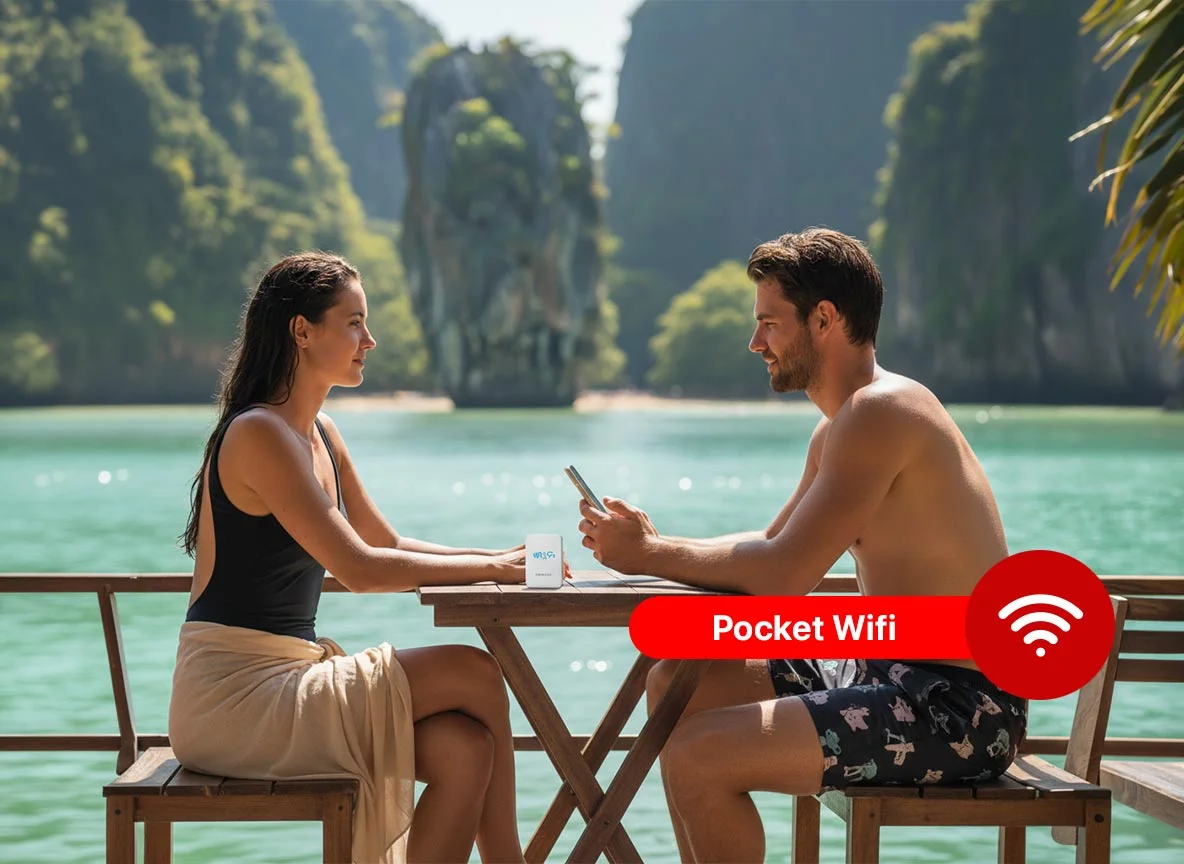
Pocket WiFi in Thailand is the local term for a portable LTE hotspot rented for a trip. The device is a battery-powered router roughly the size of a deck of cards, holding a Thai data SIM and broadcasting a private WiFi network for the traveller's phones, tablets, and laptops. Pickup happens at an airport counter, by hotel pre-delivery, or by domestic post for travellers staying long-term in a Thai address.
Two carriers underpin the rental fleet: AIS and True. The 2023 merger of dtac and TrueMove H consolidated the second-largest network under the True brand, leaving Thailand with two dominant operators plus state-owned NT in a smaller share. Most Pocket WiFi providers ride on AIS LTE; some, including SAMURAI WiFi and Travelers WiFi, run dual-SIM units that can swap between AIS and True. The same two networks are the local partners for prepaid Thai eSIMs, which means coverage in Bangkok, Phuket, Chiang Mai, and Koh Samui is identical between a rental Pocket WiFi and an installed eSIM profile in 2026.
Battery life is shorter than the Japanese fleet. Most Thai Pocket WiFi units run six to twelve hours on a charge, with the budget routers from ThaiSims and Klook closer to the lower end. Heavy daytime use on the BTS Skytrain and around the Sukhumvit shopping districts will drain a smaller unit before evening, and most providers include a USB cable and sometimes a small power bank for top-up charging.
Half a dozen providers cover the bulk of inbound rental volume at Suvarnabhumi and Don Mueang. Pricing on the budget end is more aggressive than Japan or South Korea, with ThaiSims sitting close to USD 1 per day. The headline rates below are the published 2026 figures and may exclude airport handling fees and damage deposits.
The arithmetic is sharp at the budget end. ThaiSims at THB 35 a day is roughly the same total as the cheapest Thai Tourist SIM (AIS Traveller from THB 49 for the entry tier), so a multi-week rental does not blow the budget. The trade-off is that a Tourist SIM gives a Thai phone number, useful for Grab and food-delivery verification, while a Pocket WiFi keeps the home number reachable for SMS verification.
Reserve before you fly. Walk-up rentals exist at Suvarnabhumi and Don Mueang counters, but every major provider runs reservation-first systems with online discounts of 20–40%. Booking on Klook, KKday, or directly with ThaiSims, MUAYTHAI WiFi, or SAMURAI WiFi a few days before arrival locks in the daily rate, the device tier, and the pickup slot.
Choose your pickup airport carefully. Suvarnabhumi (BKK) hosts the largest counter cluster, with ThaiSims, MUAYTHAI WiFi, SAMURAI WiFi, SMILE WiFi, and Klook all operating booths near the arrivals concourse on the second and fourth floors. Don Mueang (DMK) covers the budget AirAsia and Nok Air arrivals with a thinner provider mix. Phuket (HKT) and Chiang Mai (CNX) cover the major fleets but not always the smaller ones. Travellers landing at Krabi or Koh Samui usually need hotel pre-delivery instead.
Expect a credit card or cash deposit. Most providers reserve THB 1,000–3,000 against a card at pickup, while a few request a small cash deposit instead. The hold is released on safe return; a damaged or lost device triggers a charge of THB 3,000–7,000. Optional damage insurance for THB 30–60 per day caps the loss exposure.
Plan the return path before the last day. Counter drop at the same airport works for a round-trip from Bangkok. A one-way exit through Phuket after a Suvarnabhumi pickup, or a 04:00 KKday minivan to a Cambodian border crossing, usually means returning by Thai Post in the prepaid envelope provided. The unit must be postmarked by the agreed end date or daily late fees stack.
Carry a backup data option for island and border travel. Coverage on the Phuket-Krabi-Koh Samui ferry routes is solid on AIS and True but drops in some inland Khao Sok and northern Mae Hong Son loops. A travel eSIM running on the second SIM slot of the phone bridges these gaps and avoids the situation of a group losing all data when the Pocket WiFi drops a tower.
Three traveller profiles save money and friction by skipping Pocket WiFi entirely in Thailand. The first is the solo traveller or couple with one or two phones on a trip of any length. A 7-day Thailand eSIM lands at roughly THB 250–400, the same band as ThaiSims at the budget end and clearly under MUAYTHAI WiFi, SAMURAI WiFi, or SMILE WiFi for the same week. No deposit hold, no counter pickup, no return.
The second profile is the multi-country South-East Asia itinerary. A traveller with onward stops in Vietnam, Cambodia, or Laos cannot use a Thai Pocket WiFi across the border without voiding the rental. A regional eSIM or three single-country profiles activate in sequence with no hardware to return. The Phuket-onwards-to-Phnom-Penh sequence is one of the strongest eSIM-over-Pocket-WiFi cases.
The third profile is the short business or transit trip. A two-night Bangkok stopover does not justify the kiosk queue, the deposit, or the return logistics; an eSIM activates in the airport lounge before immigration. Pocket WiFi keeps its edge for groups of four or more sharing a single device and for travellers whose phones do not support eSIM (older Android handsets and some carrier-locked iPhones from before 2018).
The trade-offs sharpen once a traveller stops thinking of Pocket WiFi as the default. The hardware-versus-software split is the main axis: Pocket WiFi adds a device, a deposit, a pickup-and-return cycle, and a battery to manage. A TurkSIM eSIM downloads to the existing phone in minutes.
A TurkSIM Thailand eSIM connects to AIS and True, the same backbones the dominant Pocket WiFi fleets use. Coverage on the BTS Skytrain, the Bangkok MRT, the Phuket-Krabi-Koh Samui ferry routes, and the wider regional rail and bus map is identical to the rental experience. The difference is what the traveller carries: an eSIM profile lives on the phone alongside the home line, so a UK or Australian SIM stays reachable for bank verification SMS while data flows over the Thai profile.
The cost gap matters most on island and multi-week trips. A 14-day Phuket-Koh Samui beach holiday with SMILE WiFi at THB 210 a day and a THB 1,000 deposit hold runs to roughly THB 2,940 in real outlay, plus the daily ritual of charging the unit. The same trip on a Thailand eSIM lands closer to THB 500–800 with no card hold and no recharge ritual. For a multi-country South-East Asia loop, the eSIM gap widens further: each border crossing on Pocket WiFi forces a return to the Bangkok counter or a forfeit of the deposit.
Compatibility is the main gate. Most modern phones support eSIM, including the Apple iPhones, recent Samsung Galaxy and Google Pixel models, and most Android flagships from 2022 onwards. The full list lives on the eSIM compatible devices reference, and installation takes five minutes via the standard how to install eSIM walkthrough. Travellers carrying older Android phones, some China-region iPhones without eSIM enabled, or shared-use group hardware still benefit from Pocket WiFi. Everyone else has a softer route to Thai data than queuing at the Suvarnabhumi counter on the second floor.
Daily rates start at around THB 35 (USD 1) on ThaiSims and climb to THB 200–250 for unlimited mid-tier providers like SMILE WiFi or Travelers WiFi. Premium dual-SIM rentals from SAMURAI WiFi or specialist long-stay units sit closer to THB 300. Add a credit card deposit of THB 1,000–3,000; this is released on safe return.
The major brands all run counters at Suvarnabhumi (BKK) on the second and fourth floors of the main terminal. Don Mueang (DMK) covers AirAsia and Nok Air arrivals with a thinner provider mix. Phuket (HKT) and Chiang Mai (CNX) host the larger fleets like ThaiSims, MUAYTHAI WiFi, and Klook. Hotel pre-delivery covers travellers landing at Krabi or Koh Samui.
Some plans are genuinely unlimited and some are not. MUAYTHAI WiFi, SMILE WiFi, and the SAMURAI dual-SIM rental run without a hard daily cap. Klook's mid-tier rental falls back to 3G after a daily allowance is reached. ThaiSims' lowest tier is volume-capped. Always check whether the daily cap exists in the fine print before booking.
For a solo traveller or couple, a Thailand eSIM matches or undercuts most Pocket WiFi rentals on price. A 7-day eSIM lands at THB 250–400 against THB 245–1,470 for the same week of Pocket WiFi. Pocket WiFi flips ahead only when a group of four or more shares a single device or when uncapped premium speed is essential.
Yes. Coverage rides on AIS or True, both of which have national LTE footprints reaching Phuket, Krabi, Koh Samui, Chiang Mai, Chiang Rai, and the Isaan north-east. Some inland Khao Sok and Mae Hong Son loops show weaker signal, and ferries between mainland and outer islands can drop briefly. Dual-SIM rentals like SAMURAI WiFi auto-switch carriers in these gaps.
Most providers place a credit card hold of THB 1,000–3,000 at pickup as a damage and loss deposit, which is lower than the Japanese or Korean equivalents. The hold is released on safe return. Optional damage insurance at THB 30–60 per day caps the worst-case charge if the device is lost, broken, or returned late.
No. Thai rental Pocket WiFi devices are configured for domestic Thai data SIMs and lose service at the border. Crossing into Cambodia, Laos, Vietnam, or onward to Singapore voids the rental terms. Travellers with multi-country South-East Asia itineraries are better served by a regional eSIM or country-specific eSIM profiles activated in sequence.
For a solo traveller, an AIS Traveller or True Tourist SIM at THB 49–49 for 7 days often beats Pocket WiFi on price and gives a Thai phone number for Grab and food-delivery verification. For a group sharing one device, Pocket WiFi keeps its edge. For travellers who want to keep their home phone number reachable, an eSIM combines both: Thai data on the local profile and home SMS on the original line.
More on connectivity in Thailand and Asia: