Disclaimer: The prices and information presented on this page reflect a snapshot at the time of research and may change at any time without prior notice.

Liam
06 May 2026


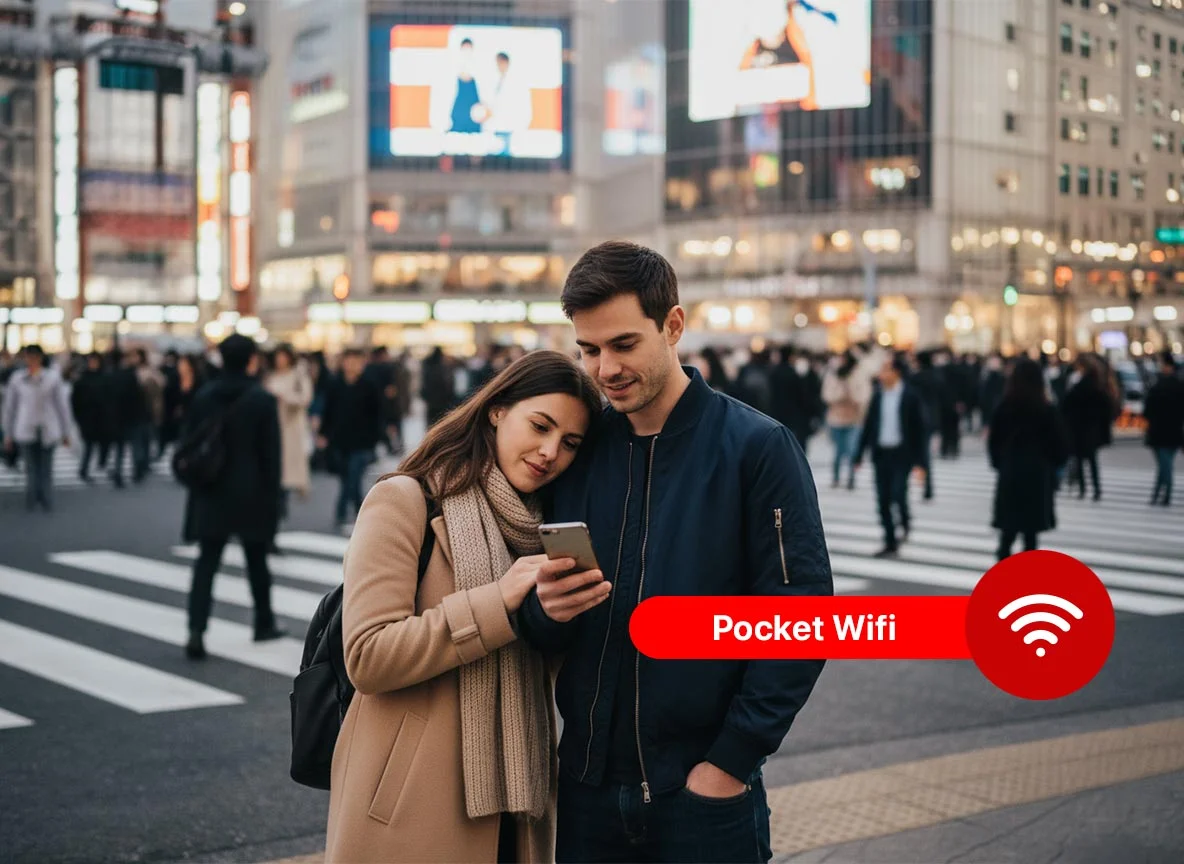
Five years ago, anyone landing at Narita Terminal 1 would queue at the WiFi rental counter alongside half the inbound flight, hand a credit card across for the deposit, and walk off with a portable hotspot in a paper sleeve. In 2026 the queue is shorter. Travel eSIMs have absorbed the solo-traveller market: Mobal averaged 165 Mbps download in its January 2026 5G eSIM rollout, and prepaid Japan eSIMs from ¥990 are now sold from a phone screen rather than an airport counter. Pocket WiFi still earns its place for groups, for travellers without an eSIM-compatible handset, and for trips that need uncapped data on multiple devices. The rental decision in 2026 is less about which device and more about whether to rent at all.
Pocket WiFi in Japan is the local label for a portable LTE hotspot. The device is a battery-powered router roughly the size of a stack of credit cards, holding a Japanese mobile data SIM and broadcasting a private WiFi network for the traveller's phones, tablets, and laptops. Pocket WiFi is rented, not bought: pickup happens at an airport counter, by hotel pre-delivery, or by domestic post for travellers staying with friends.
Almost every rental fleet in Japan rides on either NTT Docomo or SoftBank LTE. Ninja WiFi, Japan Wireless, and Pupuru lean Docomo. Sakura Mobile maintains a Docomo-based MVNO bundle. Mobal sits on SoftBank in part of its range. The footprint is therefore identical to what a prepaid Japan eSIM connects to, because TurkSIM and the major eSIM platforms also run on Docomo and SoftBank as their local partners. The choice between Pocket WiFi and a Japan eSIM is not a coverage choice in 2026: both deliver the same towers. It is a choice between hardware-and-deposit logistics or a software profile downloaded before the flight.
Battery life is the practical limit. A typical Pocket WiFi runs eight to twenty hours on a charge depending on load and network. Heavy tethering during a Tokyo metro day will drain a smaller unit before evening. The newer Sakura and Ninja units include 20-hour cells; older devices in budget rental fleets stay closer to ten.
Six providers dominate the rental fleet at Japanese airports and hotels. Pricing is set by daily rate, with multi-day discounts kicking in at seven, fourteen, and thirty days. The headline rates below are the published 2026 figures and exclude airport handling fees of ¥550–¥660 charged at most counters.
Sakura's fair-use clause matters: the marketing line says unlimited, but heavy data days above three to five gigabytes trigger throttling for the rest of that calendar day. Ninja's true-unlimited plan, by contrast, runs without a daily ceiling but at a higher headline daily rate. Japan Wireless is the typical pick for two-week and three-week trips because the long-stay rate undercuts every competitor.
Reserve before you fly. Walk-up rentals exist at the larger airport counters, but Ninja WiFi, Japan Wireless, and Sakura all run reservation-first systems. Booking online at least three days before arrival locks in the device, the daily rate, and the pickup slot. Walk-ups can pay 20–40% more.
Choose airport counter or hotel pre-delivery. Narita Terminals 1 and 2, Haneda Terminals 2 and 3, and Kansai Terminal 1 host every major rental brand. Counters at smaller airports like Chubu, Fukuoka, New Chitose, and Naha cover Ninja and Sakura but not always the smaller fleets. Travellers landing late should verify the counter's last pickup time: most close between 21:00 and 22:30, and an after-hours arrival means a hotel pre-delivery the following morning.
Expect a credit card hold for the deposit. Most providers reserve ¥10,000–¥50,000 against the card at pickup. The hold is released on safe return; a damaged or lost device triggers a charge ranging from ¥10,000 for a battery to ¥40,000 for a full unit. Optional insurance for ¥110–¥220 per day caps the loss exposure.
Plan the return path before the last day. Counter drop at the airport works for travellers leaving from the same terminal as their pickup. A different airport, a Shinkansen exit, or a 06:00 departure usually means returning by Japan Post: the unit goes into the prepaid envelope provided at pickup, sealed in any post box or konbini collection point. The return must be postmarked by the agreed end date.
Keep a backup data option for travel between regions. Coverage on the Shinkansen tunnels, on rural Hokkaido routes, and inside some Tokyo metro stations can drop briefly even with a Docomo-based device. A travel eSIM running on the second SIM slot of the phone bridges these gaps and avoids the situation of a group losing all data when the Pocket WiFi drops a tower.
Three traveller profiles save money and friction by skipping Pocket WiFi entirely in Japan. The first is the solo traveller or couple with one or two phones. A 7-day Japan eSIM lands at ¥1,500–¥2,500, less than a single rental day at most providers and free of any deposit hold. The second profile is the short-trip business or transit traveller. A two-night Tokyo stopover does not justify the counter queue, the airport handling fee, the deposit hold, or the return logistics; an eSIM activates in the airport lounge before immigration.
The third profile is the multi-country itinerary. A traveller landing in Tokyo with onward stops in Bangkok and Singapore would need three separate Pocket WiFi rentals or carry the Japan unit across borders, which usually voids its terms. A regional eSIM or three single-country profiles activate in sequence with no hardware to return.
Pocket WiFi keeps its edge in two cases: a group of five or more sharing a single device, where the per-person daily cost falls below an individual eSIM, and travellers whose phones do not support eSIM (older Android handsets, some carrier-locked iPhones from before 2018, and devices sold in mainland China without eSIM enabled).
The trade-offs sharpen once a traveller stops thinking of Pocket WiFi as the default. The hardware-versus-software split is the main axis: Pocket WiFi adds a device, a deposit, and a pickup-and-return cycle, while a TurkSIM eSIM downloads to the existing phone in minutes.
A TurkSIM Japan eSIM connects to NTT Docomo and SoftBank, the same backbone the major Pocket WiFi fleets use. Coverage on the Yamanote line, the Shinkansen between Tokyo and Kyoto, the Kansai metro network, and the wider regional rail map is identical. The difference is what the traveller carries: an eSIM profile lives on the phone alongside the home line, so a UK or Australian SIM stays reachable for bank verification SMS while data flows over the Japanese profile.
The financial gap widens on shorter trips. A 3-day Tokyo stopover with a Pocket WiFi rental at ¥770 per day plus the ¥660 airport handling and a ¥10,000 deposit hold runs to roughly ¥2,970 in real outlay. The same trip on a Japan eSIM lands closer to ¥1,000, with no hold against a credit card. For a two-week trip, the typical Ninja or Pupuru rental costs ¥10,780 plus handling. A 14-day Japan eSIM from a major prepaid platform sits between ¥2,500 and ¥4,500.
Compatibility is the main gate. Most modern phones support eSIM, including the iPhone 17, recent Samsung Galaxy and Google Pixel models, and most Android flagships from 2022 onwards. The full list lives on the eSIM compatible devices reference, and installation takes five minutes via the standard how to install eSIM walkthrough. Travellers carrying older Android phones, some China-region iPhones without eSIM enabled, or shared-use group hardware still benefit from Pocket WiFi. Everyone else has a softer route to Japanese data than queuing at the airport counter.
Daily rates start at around ¥440 for limited-data plans and ¥770 for unlimited plans on the major rental fleets. Long-stay discounts bring Japan Wireless down to roughly ¥695 per day on a 30-day rental. Add a ¥550–¥660 handling fee per pickup at most airport counters and a refundable deposit hold of ¥10,000–¥50,000.
The major brands all run counters at Narita Terminals 1, 2, and 3, Haneda Terminals 2 and 3, and Kansai Terminal 1. Smaller airports like Chubu, Fukuoka, New Chitose, and Naha have Ninja and Sakura counters but not every smaller fleet. Hotel pre-delivery and domestic post delivery cover travellers landing outside counter hours.
Some plans are genuinely unlimited, and some are not. Ninja WiFi's premium plan and Japan Wireless run without a daily cap. Sakura Mobile's marketing says unlimited, but heavy days above three to five gigabytes trigger throttling for the rest of the day. Always check whether the daily cap exists in the fine print before booking.
For a solo traveller or couple on a trip of any length, a Japan eSIM is almost always cheaper. A 7-day Japan eSIM costs ¥1,500–¥2,500 against ¥5,390–¥7,700 for the same week of Pocket WiFi rental. Pocket WiFi flips ahead only when a group of five or more shares a single device.
Yes. Coverage rides on NTT Docomo or SoftBank, both of which have national LTE footprints reaching Hokkaido, Kyushu, Shikoku, and the Okinawa main islands. Some rural and mountain areas show weaker signal, and Shinkansen tunnels drop coverage briefly. The remote Okinawa outer islands sometimes carry a small surcharge or longer delivery time.
Most providers place a credit card hold of ¥10,000–¥50,000 at pickup as a damage and loss deposit. The hold is released on safe return. Optional damage insurance at ¥110–¥220 per day caps the worst-case charge if the device is lost, broken, or returned late.
No. Japanese rental Pocket WiFi devices are configured for domestic Japanese data SIMs and lose service at the border. Crossing into South Korea, Taiwan, or onward to Southeast Asia voids the rental terms. Travellers with multi-country itineraries are better served by a regional eSIM or country-specific eSIM profiles activated in sequence.
The hotspot stops broadcasting and reconnects after charging. Most rentals include a USB-C or micro-USB charging cable, and providers like Ninja and Sakura include a small power bank for newer plans. Heavy daytime use on older units typically requires a top-up charge over lunch to make it through to evening.
More on connectivity in Japan and Asia: