
Disclaimer: The prices and information presented on this page reflect a snapshot at the time of research and may change at any time without prior notice.

Liam
06 May 2026


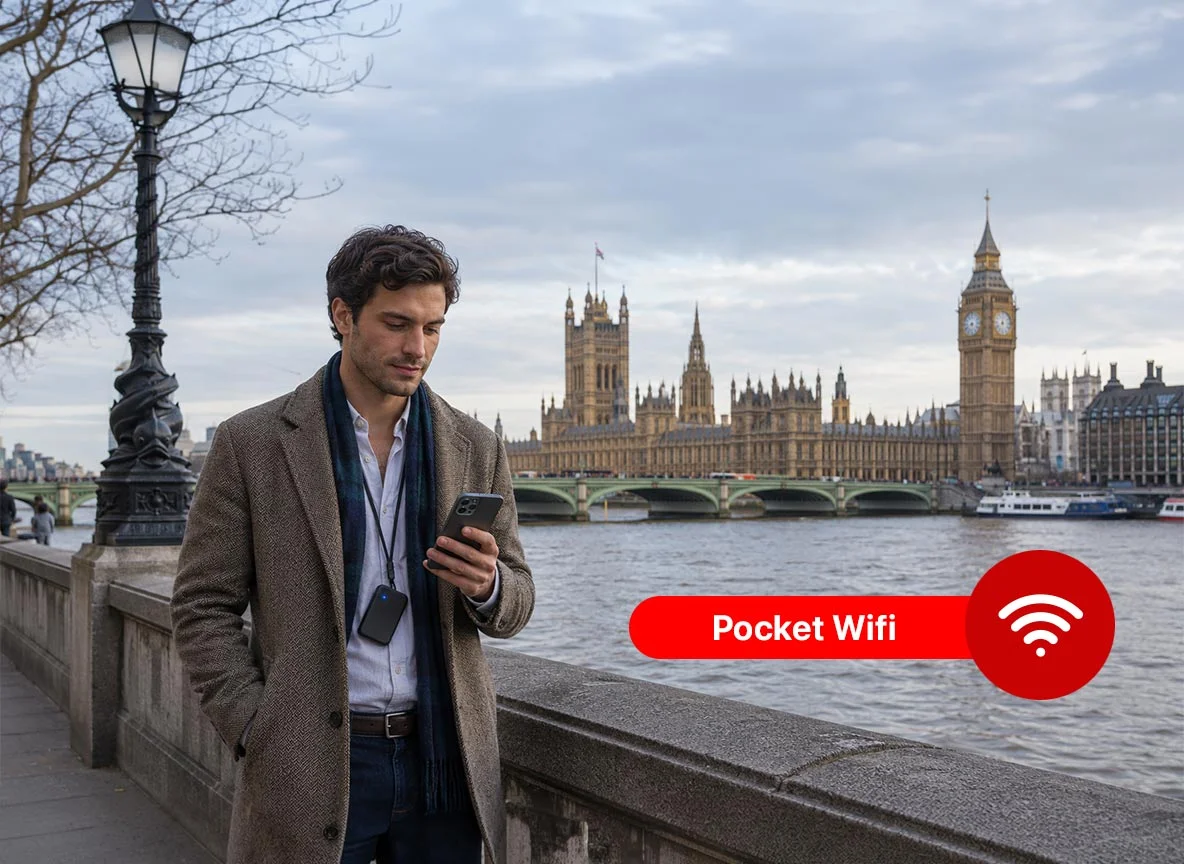
Sixteen hundred dollars in roaming charges for ten days in London. That is the bill an AT&T Mobility customer received in summer 2024 after forgetting to enable the International Day Pass before landing at Heathrow. The pay-per-use rate of USD 2.05 per megabyte, applied to a phone that downloaded background app updates and streamed Google Maps from Tower Bridge to Buckingham Palace, stacked the surcharges within hours. Verizon charges the same per-megabyte rate without TravelPass active. Australian Telstra runs AUD 5–10 a day, Canadian Bell Roam Better is CAD 16. Pocket WiFi in the UK exists for exactly this set of inbound visitors who do not want to gamble on their home carrier's day-pass enrollment, and who, since Brexit, can no longer assume EU Roam Like at Home applies on a flight from Paris or Amsterdam.
Pocket WiFi in the UK is a portable LTE or 5G hotspot rented by inbound visitors. The device holds a British data SIM and broadcasts a private WiFi network for the traveller's phones, tablets, and laptops. Pickup happens by courier delivery to a London hotel for most fleets, with a few options at Heathrow (LHR) and Gatwick (LGW) on a pre-booked basis.
Four nationwide carriers anchor the rental fleet: EE, Vodafone UK, O2, and Three. EE runs the densest 5G rollout in London, Manchester, and Birmingham, with an Ofcom-leading 4G footprint reaching Cornwall, the Lake District, and the Scottish Highlands. Vodafone UK runs second nationally, with strong urban 5G in the same cities. O2 and Three trail in 5G but match on 4G LTE in metro areas. Most rental fleets ride on EE for the breadth of coverage, with Vodafone-based units common on the international fleets shipping from continental Europe. The same four carriers are the local partners for prepaid UK visitor eSIMs, so coverage on the London Underground, the West Coast Main Line, the Heathrow Express, and the Caledonian Sleeper to Inverness is identical between rental and eSIM in 2026.
Battery life on UK rentals runs 8 to 12 hours, with the longer cells on Hippocket WiFi and My Webspot units suited to a day-long Cotswolds drive or a Bath-Salisbury-Stonehenge loop. Most rentals support 5 to 10 connected devices.
Half a dozen international providers dominate the UK rental market. There is no equivalent of Spain Internet's local-office walk-up; the British market runs courier-only with rare airport pickup. Pricing sits at GBP 6–15 per day, with weekly bundles running GBP 50–100 plus shipping fees on international fleets.
Travel WiFi at GBP 6.30 a day is the budget benchmark for inbound visitors. Hippocket WiFi at GBP 9.15 is the strongest pick for travellers combining the UK with continental Europe on the same trip; the unit handles cross-border use into France, Germany, Italy, or Spain without action. Cello Mobile is the outlier premium option for business travellers who need concierge support during a five-day City of London visit.
Pre-book courier delivery to a London hotel. Travel WiFi, Hippocket WiFi, Travelers WiFi, My Webspot, XOXO WiFi, and Cello Mobile all default to courier delivery to a hotel reception two to three days before arrival. Heathrow Express and Gatwick Express both stop near central-London hotels, which means the unit is waiting at the front desk on check-in. Manchester and Edinburgh travellers receive identical hotel-delivery service.
Walk-up airport rental is rare. Heathrow (LHR), Gatwick (LGW), Stansted (STN), and Manchester (MAN) do not host the airport-counter Pocket WiFi rental scale that Asia or Mexico offers. A few providers offer Heathrow Terminal 2 or 5 pickup as a paid add-on, but the volume is small. Last-minute travellers who land without a courier-delivered unit usually buy a UK Pay-As-You-Go SIM at the airport WHSmith newsagent instead.
Pre-book at least three days before the flight. Continental fleets like Travel WiFi and Hippocket WiFi ship from France or Switzerland, so allow extra time for cross-Channel customs delays. UK-based fleets ship faster but still need 48-hour notice. Last-minute holders should consider an eSIM, which activates within minutes regardless of arrival timing.
Expect a GBP 100 to GBP 200 credit card hold. Most providers reserve GBP 100 against the card at delivery; premium fleets like Cello Mobile reserve up to GBP 200 (USD 250). The hold is released on safe return; a damaged or lost device triggers a charge of GBP 200–350. Optional damage insurance for GBP 1–2 per day caps the loss exposure.
Plan for the four-nation cross-border within the UK. The UK is a single mobile market across England, Scotland, Wales, and Northern Ireland, so Pocket WiFi works across all four without action. Coverage thins in the Scottish Highlands, the North York Moors, parts of mid-Wales, and the Northern Irish glens, where even EE and Vodafone show weak signal. Travellers heading off the M-network grid should download offline maps before leaving Edinburgh, Cardiff, or Belfast.
Three traveller profiles save the most by skipping Pocket WiFi entirely in the UK. The first is the solo traveller or couple with eSIM-capable phones on a city-focused trip. A 7-day UK eSIM lands at GBP 8–15 against GBP 44–80 for the same week of Pocket WiFi rental. The second is the multi-country itinerary traveller routing London-Paris-Amsterdam; a UK Pocket WiFi voids at the Eurostar terminus, while a regional eSIM activates on each landing. The third is the short business or transit traveller, where a two-night London stopover does not justify the courier-delivery window or the deposit hold.
For US travellers in particular, the eSIM sidesteps the per-megabyte AT&T or Verizon trap. AT&T Mobility's USD 2.05 per megabyte without TravelPass active applied to a typical 1 GB day of background use stacks to roughly USD 2,000 for a single day. The same day on a UK eSIM costs USD 1–3. The risk is asymmetric: Pocket WiFi rental at GBP 6–12 a day, eSIM at GBP 1–2 a day, accidental PPU on AT&T at unbounded USD per megabyte.
Pocket WiFi keeps a narrower edge for groups of four or more sharing a single device on a multi-week London stay, for travellers without an eSIM-compatible phone (older Android handsets, mainland-China-region iPhones), and for travellers who want to keep a separate device from their personal phone for work-related browsing.
The trade-offs sharpen for inbound visitors hit by their home-carrier roaming surcharges. The rental adds a deposit, a courier window, and a return cycle. A TurkSIM eSIM downloads to the existing phone in minutes.
A TurkSIM United Kingdom eSIM connects to EE, Vodafone, and O2, the same backbones the major Pocket WiFi fleets use. Coverage on the London Underground, the Heathrow Express and Gatwick Express, the West Coast Main Line to Glasgow, the Eurostar between London and Paris (in the UK leg), and the Caledonian Sleeper to Inverness is identical between rental and eSIM. The wider Europe eSIM covers all 36 EEA countries plus the UK on a single profile for travellers crossing the Channel within a single trip.
The cost gap is sharpest for US visitors. A 5-day London business stop with AT&T International Day Pass at USD 12 a day adds USD 60 to the home phone bill (or USD 2,000+ if the Day Pass was not enabled). The same week on a UK eSIM lands at GBP 8–15 (USD 10–19) with no card hold and no Day-Pass-enrollment risk. Australian Telstra customers save against the AUD 5–10 daily rate; Canadian Bell customers against CAD 13–16 daily.
Compatibility is the gating question. Most modern phones support eSIM, including Apple, recent Samsung and Google models, and most Android flagships from 2022 onwards. Every iPhone sold in the United States since 2022 is eSIM-only by design. The full list lives on the eSIM compatible devices reference, and installation takes five minutes via the standard how to install eSIM walkthrough. Travellers carrying older Android phones, mainland-China iPhones without eSIM, or shared-use group hardware on a multi-week UK family stay still benefit from a Pocket WiFi rental. Everyone else has a softer route to British data than waiting on courier delivery to a London hotel.
Daily rates start at GBP 6.30 on Travel WiFi and run to GBP 11.85 on Cello Mobile premium. Most mainstream options sit at GBP 8–10 a day. Add a credit card hold of GBP 100–200 for the device deposit; this is released on safe return.
Most UK rentals deliver by courier to a London, Manchester, or Edinburgh hotel two to three days before arrival. Heathrow and Gatwick airport pickup is available with a few providers as a paid add-on but is rare compared to Asian or Mexican airports. Walk-up airport-counter rental at the scale of Changi or Suvarnabhumi does not exist in the UK.
Last-minute travellers usually buy a UK Pay-As-You-Go SIM at the airport WHSmith newsagent or a Three, EE, or O2 retail kiosk in the arrivals concourse. The cheapest option is a Three or Lyca PAYG starter pack at GBP 5–10 with a small data allowance, useful for the first few hours until a longer-term solution is set up. Most travellers prefer a pre-installed eSIM activated before takeoff.
For a solo traveller or couple with eSIM-capable phones, a UK eSIM is materially cheaper. A 7-day eSIM lands at GBP 8–15 against GBP 44–100 for the same week of Pocket WiFi rental. The eSIM also avoids the courier-delivery window and the deposit hold. Pocket WiFi flips ahead only when a group of four or more shares a single device on a multi-week stay.
AT&T Mobility and Verizon both charge USD 2.05 per megabyte for international data without an active International Day Pass or TravelPass. A typical day of background app use, Google Maps, and casual browsing on iPhone or Android consumes 500 MB to 1 GB. At USD 2.05 per megabyte, that becomes USD 1,000–2,000 in surcharges per day. Pocket WiFi or an eSIM both bypass this PPU rate by connecting through a UK SIM instead.
Yes. The UK is a single mobile market across all four nations, so a Pocket WiFi rented in London works across England, Scotland, Wales, and Northern Ireland without action. Coverage thins in the Scottish Highlands, the North York Moors, mid-Wales, and the Northern Irish glens. EE-based rentals cover these regions best because of EE's denser rural 4G footprint.
No. UK rental Pocket WiFi devices are configured for domestic British SIMs and lose service at the border. The Eurostar to Paris, the Dublin ferry from Holyhead, or the Belfast-to-Cork drive all void the rental terms. Travellers on a London-Paris-Amsterdam itinerary are better served by a regional Europe eSIM that covers both sides of the Channel.
No, not since January 2021. Brexit ended the UK's participation in EU Roam Like at Home, so UK customers face daily roaming surcharges in Europe (Vodafone GBP 2.57, Three GBP 2 on Value plans, EE GBP 5, O2 GBP 7). The reverse applies to EU residents visiting the UK: a German Vodafone or Italian TIM contract no longer covers the UK at home rates. Both directions need a Pocket WiFi, eSIM, or accepted home-carrier surcharge.
More on connectivity in the UK, Europe, and beyond: