Disclaimer: The prices and information presented on this page reflect a snapshot at the time of research and may change at any time without prior notice.

Liam
27 March 2026


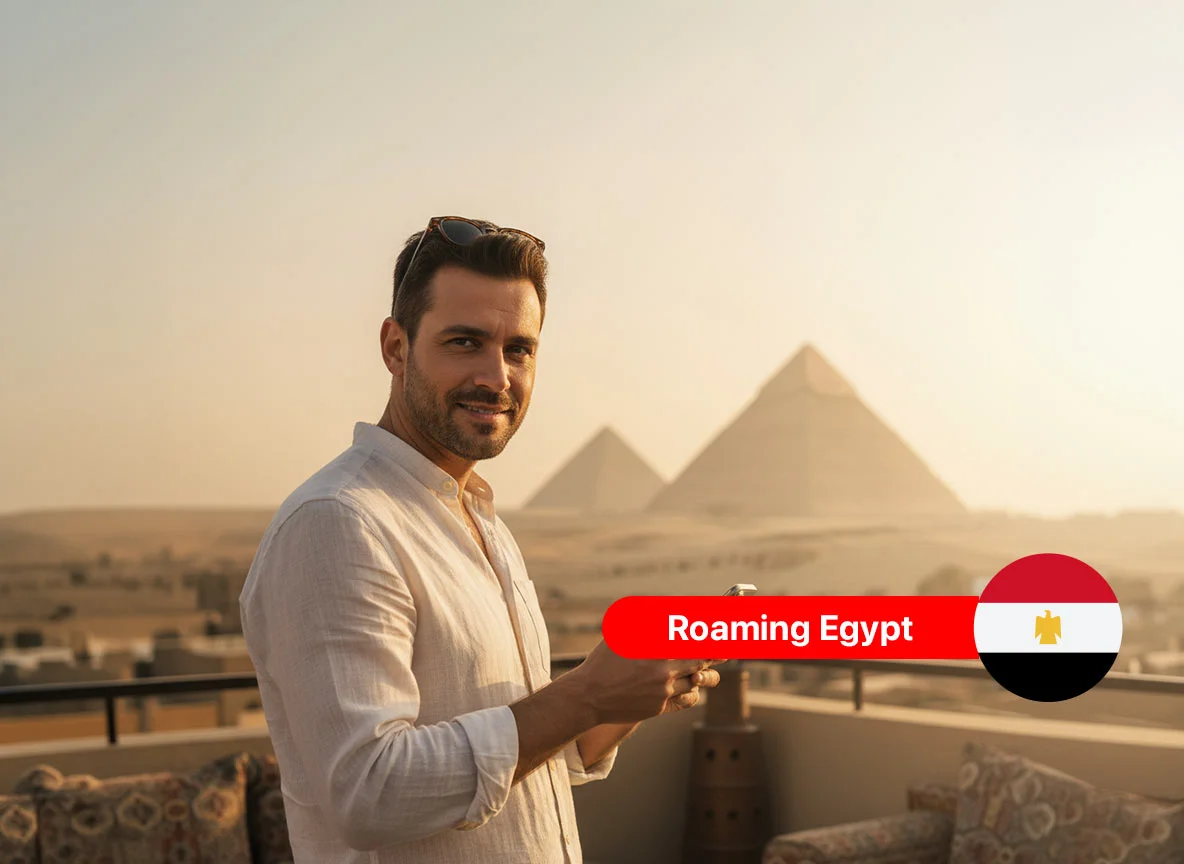
Egypt is a destination that demands connectivity from the moment you arrive. Finding your transfer at Cairo Airport, navigating the chaotic streets around Tahrir Square, booking a felucca on the Nile in Luxor, checking opening times for the Valley of the Kings, or simply pulling up Google Translate to negotiate a price in Khan el-Khalili. Your phone is your lifeline. But roaming in Egypt with an international carrier is expensive by any measure. US carriers charge $12 per day. UK carriers charge £6–£7.86/day. Without a day pass, per-megabyte rates can reach several dollars, turning a single day of casual browsing into a bill that rivals the cost of your Nile cruise cabin. This guide covers what visitors from the US, UK, Canada, Australia, and Europe actually pay for roaming in Egypt, how the local networks work, and the alternatives that deliver reliable connectivity at a fraction of the cost.
Egypt has three mobile carriers: Vodafone Egypt (the largest, with strong urban and Nile Valley coverage), Orange Egypt (good city coverage, competitive pricing), and Etisalat (now branded as e&, solid coverage in cities and resort areas). All three provide 4G/LTE in Cairo, Alexandria, Luxor, Aswan, Hurghada, Sharm el-Sheikh, and along the main Nile corridor. Coverage in the Western Desert, Sinai interior, and remote oases is more variable.
When you arrive with an international SIM, your phone connects to one of these networks through your home carrier’s roaming agreement. Egypt is classified as "Rest of World," "Zone D," or "Africa" by most international carriers. This means it falls into the most expensive roaming tier for almost every carrier outside of Africa itself.
Egypt also has strict SIM registration rules. Buying a local Egyptian SIM card requires passport registration at an official carrier shop, and the SIM may take a few hours to activate. For short visits, this process can be impractical, which is one reason why travel eSIMs have become popular for Egypt.
Disable data roaming before landing at Cairo Airport. Cairo International has free Wi-Fi in the terminal. Use it to check messages and set up your connectivity plan before enabling any roaming on your home SIM.
Local SIMs require passport registration. Vodafone Egypt, Orange Egypt, and Etisalat all sell tourist SIM cards at Cairo Airport and in city shops. You need your passport. Activation can take a few hours. For trips under a week, a travel eSIM is faster and avoids the registration hassle.
Coverage along the Nile is solid. The main tourist corridor from Cairo through Luxor to Aswan has reliable 4G coverage from all three carriers. Hurghada and Sharm el-Sheikh also have good coverage. The Western Desert (White Desert, Siwa Oasis) and deep Sinai have limited or no signal.
Download offline maps for archaeological sites. Many of Egypt’s top attractions (Karnak Temple, Valley of the Kings, Abu Simbel) are in areas with variable signal. Download Google Maps for the Luxor and Aswan regions before heading out on tours.
Use WhatsApp and Uber for local transport. Cairo’s traffic is legendary, and Uber/Careem are the most reliable transport options. Both require data. WhatsApp is the standard communication tool for hotels, tour guides, and local contacts.
Be mindful of VPN restrictions. Egypt has periodically restricted certain VoIP services. WhatsApp calls usually work, but Skype and FaceTime may be unreliable. A travel eSIM does not bypass these restrictions, as they are applied at the network level.
Egypt is one of those destinations where a travel eSIM makes a particularly strong case. The local SIM registration process adds friction for short-stay visitors. Carrier roaming is expensive across the board. And Egypt’s reliance on ride-hailing apps (Uber, Careem) and WhatsApp for daily communication makes always-on data practically essential.
A travel eSIM lets you pre-purchase a data package, install it before you leave, and activate it when you land. No passport registration, no waiting for SIM activation, no navigating a carrier shop in Arabic. Your data runs on Egyptian networks at 4G/LTE speeds from the moment you clear customs.
For travellers combining Egypt with Jordan (a classic Petra-Pyramids itinerary) or with a Red Sea resort stay followed by a Nile cruise, separate eSIM plans for each segment keep you connected without managing multiple local SIMs.
Egypt is a country where every day brings a new logistical challenge that your phone can solve. Finding the right entrance to the Egyptian Museum. Checking whether the Sound and Light show at Giza is running tonight. Booking a sunrise balloon flight over Luxor’s West Bank. Confirming your overnight train from Cairo to Aswan. All of it requires data.
TurkSIM’s Egypt eSIM connects to Etisalat and Vodafone Egypt, two networks that together cover Cairo, the Nile Valley, the Red Sea coast, and the main tourist corridors. Whether you are negotiating a taxi fare in Giza or uploading photos from Abu Simbel, the connection runs through established Egyptian infrastructure.
The cost savings are significant. A 10-day trip with AT&T roaming at $12/day costs $120. With Vodafone UK at £7.86/day, it is £78.60. A TurkSIM eSIM data package for the same period costs a fraction of those amounts, with no daily charges and no risk of overage fees.
Dual SIM keeps your home number active for calls, texts, and banking OTPs. All data flows through the Egyptian network on your eSIM. No roaming charges from your home carrier, no registration hassle, no activation delays.
US carriers charge $12/day with a day pass or $2.05/MB without one. UK carriers charge £6–£7.86/day. Australian carriers charge AUD $10/day. Without any add-on, per-megabyte rates make even basic usage very expensive.
Yes. Vodafone Egypt, Orange Egypt, and Etisalat have counters at Cairo International Airport. You need your passport for registration. Activation may take a few hours. For short trips, a pre-installed travel eSIM is faster.
4G/LTE coverage is good in Cairo, Alexandria, Luxor, Aswan, Hurghada, and Sharm el-Sheikh. Coverage along the Nile Valley between these cities is generally reliable. The Western Desert, deep Sinai, and remote oases have limited or no signal.
Egypt has periodically restricted some VoIP services. WhatsApp calls usually work. Skype and FaceTime may be unreliable. These restrictions apply at the network level and affect both roaming and local connections.
For trips under two weeks, yes. A travel eSIM activates instantly without passport registration or activation delays. For longer stays, a local SIM offers cheaper per-GB rates but requires in-person registration.
Yes. With a dual-SIM phone, keep your home SIM active for calls and texts while using the TurkSIM eSIM for data. You stay reachable on your regular number without paying roaming data charges.
Planning a Middle East or Africa trip? Find more guides: