Disclaimer: The prices and information presented on this page reflect a snapshot at the time of research and may change at any time without prior notice.

Liam
27 March 2026


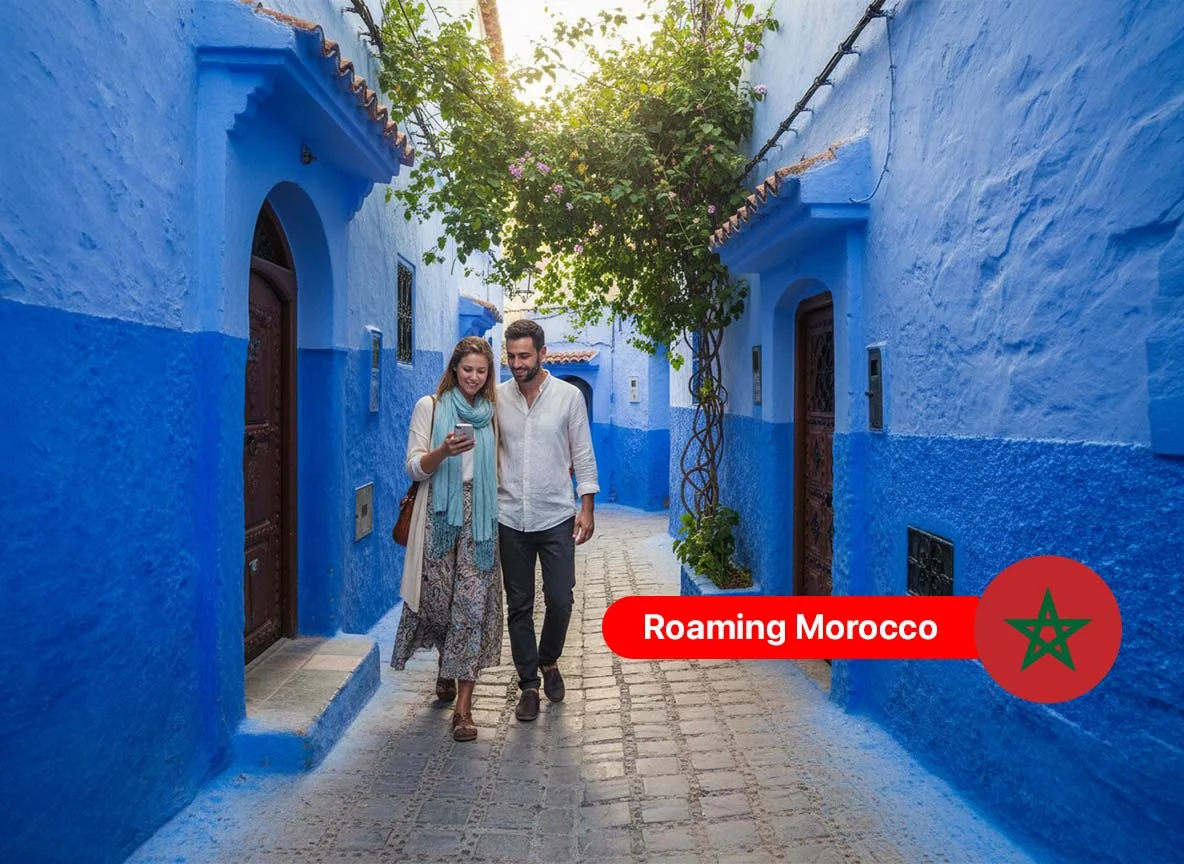
Morocco is one of those destinations that captivates from the first moment. The medinas of Marrakech and Fez, the blue streets of Chefchaouen, the Sahara dunes near Merzouga, the Atlantic coast at Essaouira, and the Atlas Mountain passes between them. Your phone helps with all of it: navigating souks where GPS is your only hope, finding your riad in a labyrinth of unmarked alleys, booking a desert tour, or checking the weather before a mountain drive. But roaming in Morocco with an international carrier is expensive. US carriers charge $12/day. UK carriers charge £6–£7.86/day. Morocco sits in the most expensive roaming zones for nearly every international carrier. Without a day pass, per-megabyte rates can generate hundreds in charges from a single day of casual phone use. This guide covers what visitors from the US, UK, Canada, Australia, and Europe pay for roaming in Morocco, how the local networks work, and the alternatives that keep you connected without the financial pain.
Morocco has three mobile carriers: Maroc Telecom (the largest, with the widest coverage including rural and desert areas), Orange Morocco (strong in cities and tourist zones), and Inwi (competitive pricing, solid urban coverage). All three offer 4G/LTE in major cities (Casablanca, Marrakech, Fez, Rabat, Tangier) and along main highways. Coverage in the Atlas Mountains and Sahara Desert is variable, with Maroc Telecom offering the most reliable signal in remote areas.
Morocco is classified as "Zone D," "Rest of World," or "Africa" by most international carriers. This places it in the most expensive roaming tier. Morocco is specifically excluded from O2 UK’s European roaming zone (which many UK travellers do not realise until they arrive). EU carriers do not include Morocco in the Roam Like at Home regulation.
Buying a local Moroccan SIM is straightforward. Maroc Telecom, Orange, and Inwi sell prepaid SIMs at airports and in shops across the country. Prices are very affordable (around 30–50 MAD for a SIM with data). You need your passport. Activation is usually immediate.
Disable data roaming before landing. Marrakech Menara, Casablanca Mohammed V, and Fez-Saïss airports have Wi-Fi. Connect to it first and set up your connectivity before turning on roaming.
Morocco is NOT in EU or O2 roaming zones. This catches many UK travellers off guard. O2’s free EU roaming does not extend to Morocco. Vodafone places Morocco in Zone D. EE charges £7.50/day (its highest zone). Always check your carrier’s Morocco classification before assuming your European roaming deal covers it.
Buy a local SIM at the airport for longer stays. Maroc Telecom, Orange, and Inwi sell tourist SIMs at all major airports. Packages with 5–20 GB of data cost 50–100 MAD (roughly £4–£8). Activation is immediate with passport. For stays over a week, this is excellent value.
Maroc Telecom has the best rural coverage. If your trip includes the Atlas Mountains, Sahara Desert, or smaller towns between the imperial cities, Maroc Telecom’s network reaches furthest. Orange and Inwi are fine in cities but weaker outside them.
Download offline maps for the medinas. Navigating Marrakech’s or Fez’s medina without GPS is a genuine challenge. Download Google Maps for these cities before entering the old town. GPS works without data and can save you from getting lost in the maze of alleys.
WhatsApp is essential in Morocco. Riads, restaurants, guides, and drivers all communicate via WhatsApp. Having data for WhatsApp is practically non-negotiable for day-to-day travel interactions.
Morocco is one of the most expensive roaming destinations for UK visitors. O2 does not include it in free EU roaming. EE charges £7.50/day (Zone D). Three charges £7/day. Vodafone charges £7.86/day. Two weeks of roaming at these rates costs £98–£110.
For US visitors at $12/day, two weeks costs $168. For Australian visitors at AUD $10/day, it is AUD $140. A TurkSIM eSIM data package for the same period costs a small fraction of any of these amounts.
A local SIM is the cheapest option if you do not mind the airport queue and passport registration. But if you want connectivity the moment you land, or if you are combining Morocco with Spain or Portugal (a common itinerary via the Tangier-Tarifa ferry), an eSIM avoids the hassle of managing multiple SIMs across borders.
Morocco is a sensory overload in the best possible way, and your phone helps you navigate it all. Finding your riad in the depths of the Fez medina (where street names do not exist). Checking whether the mountain pass to Ouarzazate is open. Booking a camel trek from Merzouga. Translating a conversation with a spice vendor in Marrakech. Each moment requires data, and each is dramatically cheaper with an eSIM than with carrier roaming.
TurkSIM’s Morocco eSIM connects to Inwi and Maroc Telecom, two networks that together cover the vast majority of the country. Maroc Telecom reaches into the Atlas Mountains and Sahara edges where other networks falter. Whether you are sipping mint tea in a Chefchaouen café or watching the sunset from Aït Benhaddou, the connection runs through established Moroccan infrastructure.
For UK visitors, the Morocco-specific savings are among the largest of any destination. Vodafone UK’s £7.86/day for Zone D and EE’s £7.50/day make two weeks of roaming cost over £100. A TurkSIM data package costs a fraction of that. For visitors combining Morocco with Spain (the Tangier-to-Andalusia route is increasingly popular), a separate Europe eSIM for the Spanish leg keeps costs predictable at each border.
Dual SIM keeps your home number active for banking codes, WhatsApp, and emergency calls. All data runs through the Moroccan network at local speeds. No roaming charges, no zone confusion, no bill surprises.
UK carriers charge £6–£7.86/day. US carriers charge $12/day. Australian carriers charge AUD $10/day. O2 UK does NOT include Morocco in its free EU roaming zone. Without a pass, per-megabyte rates are extremely expensive.
No. Morocco is excluded from O2’s European roaming zone. O2 customers need a separate Data Roaming Bolt On (£26–£65) or will face pay-per-use rates of £7.20/MB.
Yes. Maroc Telecom, Orange Morocco, and Inwi sell prepaid SIMs at all major airports and in city shops. Prices are very affordable (30–50 MAD for a SIM plus data). You need your passport. Activation is usually immediate.
Maroc Telecom has the widest coverage, especially in rural areas, the Atlas Mountains, and desert regions. Orange Morocco and Inwi are reliable in cities. For country-wide travel, Maroc Telecom reaches furthest.
Coverage in the Sahara is limited and depends on proximity to towns like Merzouga or Zagora. Maroc Telecom has the best desert-edge coverage. Deep in the dunes, expect no signal from any carrier.
Yes. Dual-SIM phones let you keep your home SIM for calls and texts while the eSIM handles data. You stay reachable and avoid roaming data charges.
On a UK carrier visiting Morocco? Find your roaming guide: