
Disclaimer: The prices and information presented on this page reflect a snapshot at the time of research and may change at any time without prior notice.

Aisha
09 March 2026


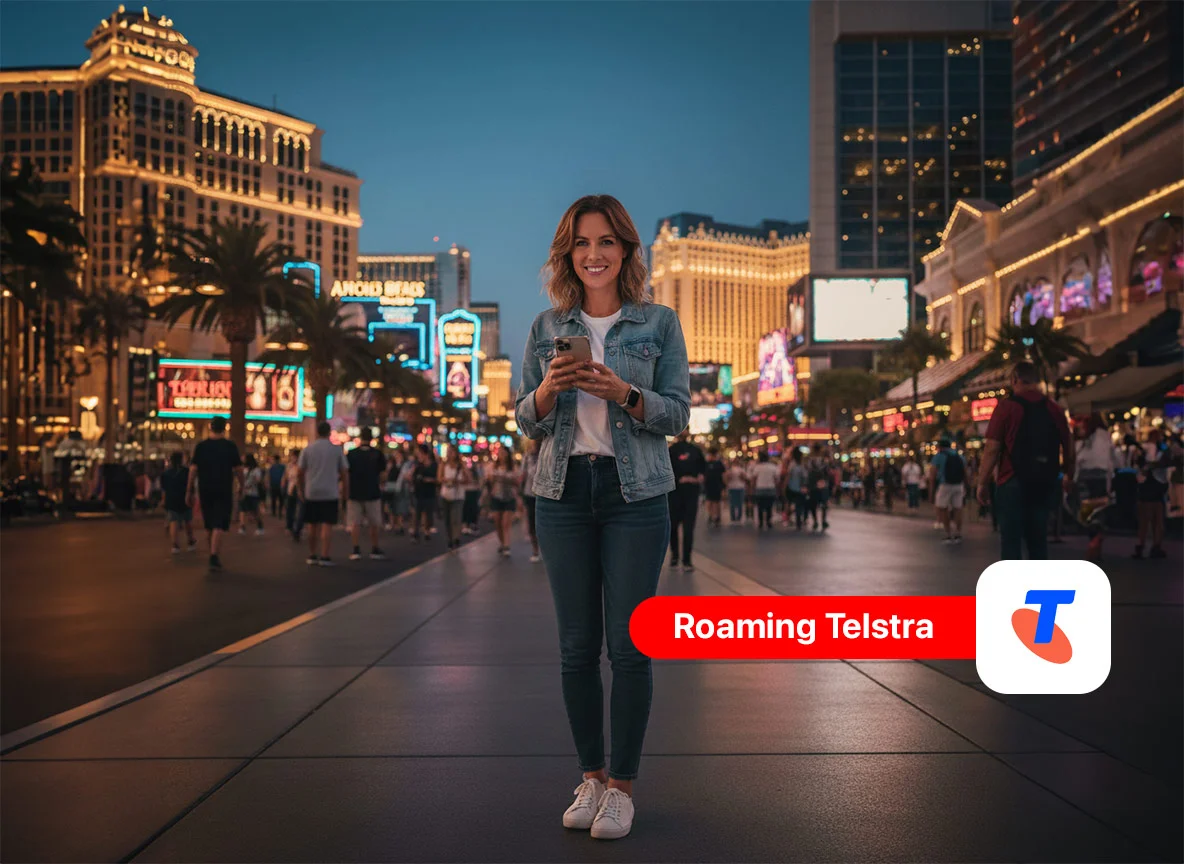
You land at LAX, flip off airplane mode, and your phone connects to AT&T or T-Mobile through Telstra's roaming agreement. Seamless. Then the bill arrives. For Australian travellers heading to the United States, Telstra roaming works reliably — but it comes at a cost that adds up fast on anything longer than a weekend trip. Whether you are planning a two-week road trip through the Southwest, a business week in New York, or a month exploring the national parks, understanding exactly how Telstra's USA roaming options work will help you avoid the kind of bill shock that can sour the end of a great holiday. This guide covers every current option, what each one actually costs, and when a dedicated travel eSIM is the smarter call.
Telstra customers travelling to the United States can use their existing Australian number for calls, SMS, and mobile data. The connection runs through partner networks, primarily AT&T and T-Mobile, so coverage across major cities and interstate highways is generally solid. You do not need to do anything special with your SIM. International roaming is enabled on most Telstra plans by default, though it is worth confirming in the My Telstra app before you fly.
The USA falls under Telstra’s Zone 2 classification. That means if you are on a postpaid Upfront Plan, the International Roaming Day Pass costs AUD $10 per day. This gives you 2 GB of data, plus unlimited standard calls and SMS for that 24 hour window. If you exceed the 2 GB daily cap, Telstra charges an additional $10 per 2 GB top up. The daily allowance does not roll over, and critically it resets at midnight Australian Eastern time, not local US time. A traveller in Los Angeles is on AEST minus 18 or 19 hours depending on daylight saving, which means the daily reset happens well before midnight Pacific time. This can catch people off guard if they are trying to ration their data through the evening.
For prepaid customers, the Day Pass is not available. Instead, Telstra offers Prepaid International Roaming Packs, which are available in 38 countries including the United States. These packs give you a fixed amount of data, calls, and SMS for a set period. An important note is that the pack’s expiry clock starts from the moment of purchase, not from first use, so you should wait until you have actually arrived in the US before buying. If you do not use any roaming add on, Telstra’s Pay As You Go rates apply, and they are expensive.
Always verify current pricing in the My Telstra app before departure, as rates are subject to change.
Check your plan type first. Log into the My Telstra app and look at your account number. If it starts with 2000, you are not on an Upfront Plan and the Day Pass may not be available to you. Knowing this before you board the flight prevents nasty surprises at the airport.
Enable roaming in the app, not at the store. The My Telstra app is the fastest way to confirm roaming is active on your account. You can also turn the Day Pass on or off from there during your trip. Calling Telstra from overseas to sort out account access is nobody's idea of a fun holiday activity.
The AEST reset is not your local midnight. The Day Pass resets at midnight Australian Eastern time. If you are on the US East Coast (AEST -14 or -15 hours), your reset happens around 9 or 10 AM local time. On the West Coast, it is closer to 6 or 7 AM. Plan your heavy data use accordingly.
Prepaid customers: buy after you land. Telstra Prepaid Roaming Packs start their expiry clock the moment you purchase. Buy the pack on Australian soil, and you may have already burned a day before you have even used any data.
Turn off background app refresh. 2 GB per day sounds reasonable until your phone spends the morning syncing photos to iCloud and updating apps in the background. Before you land, disable background refresh for any app that is not essential. Your data allowance will go much further.
MMS is not included. Even on the Day Pass, MMS messages are charged separately at AUD $0.75 each. Send photos via WhatsApp or iMessage over WiFi or data instead.
For a two or three day trip to the US, a quick business visit or a long weekend in New York, the Day Pass is genuinely convenient. You stay on your Australian number, the setup takes seconds, and the cost is predictable. But there is a clear point at which the maths tips in favour of a dedicated travel eSIM.
At AUD $10 per day, a ten day US trip costs $100 in roaming fees alone. A 14 day trip hits $140. And that is assuming you never exceed the 2 GB daily cap. Heavy users, anyone navigating with Google Maps all day, streaming Spotify on a road trip, or working remotely, will regularly hit that cap and start paying $10 per additional 2 GB. The costs compound quickly.
There is also the billing cycle problem unique to prepaid customers. Telstra’s Prepaid Roaming Packs cap out at 2 GB for a two week pack. For a two week American road trip covering multiple states, that is a tight budget. A dedicated US eSIM from TurkSIM lets you choose the data volume that actually matches your itinerary, activates on arrival, and works independently of your Telstra account.
On any dual SIM device, which includes most iPhones from the iPhone XS onwards and the majority of modern Android flagships, you can run your Telstra SIM and a US eSIM simultaneously. Your Australian number stays active for calls, SMS, and banking OTPs. The eSIM handles local US data at local rates.
The USA is Australia’s most popular long haul destination for leisure travel. Most trips run between ten days and four weeks, comfortably past the point where the Telstra Day Pass makes financial sense. A three week trip to the US on the Day Pass alone costs over AUD $200 in roaming fees before a single top up is factored in.
TurkSIM’s USA eSIM connects through AT&T and T-Mobile’s local networks, meaning you get the same nationwide coverage Australian tourists rely on for road trips along Route 66, national park navigation in Utah or Colorado, or city navigation in New York, Chicago, and San Francisco, all at a fraction of the daily rate. There is no AEST midnight reset to manage. Your data is yours for the trip, not parcelled out in 24 hour windows that reset while you are still sightseeing.
For Australians on dual SIM devices, nearly every current iPhone and flagship Android qualifies, the setup is simple. Install the TurkSIM eSIM at home before you fly. Your Telstra SIM stays active for calls, texts, and Australian banking OTPs throughout the trip. The eSIM handles US data automatically once you land. No store visits. No SIM swap. No risk of losing a physical card in transit.
Yes. Telstra has roaming agreements with AT&T and T-Mobile in the USA, giving postpaid and prepaid customers access to mobile data, calls, and SMS while travelling. Coverage is strong in major cities and along main highways.
Postpaid Upfront Plan customers pay AUD $10 per day for the International Roaming Day Pass, which includes 2 GB of data and unlimited standard calls and SMS. Prepaid customers use Prepaid International Roaming Packs. Pay-As-You-Go rates are available as a fallback but are significantly more expensive. Always confirm current pricing in the My Telstra app before departure.
Telstra's Day Pass resets at midnight Australian Eastern time (AEST/AEDT). Because Australia is 14 to 19 hours ahead of US time zones, the reset happens during daylight hours in the US. For example, a traveller in Los Angeles sees their data reset around 5–6 AM Pacific time.
Yes, but the Day Pass is not available on prepaid. Instead, you use Telstra's Prepaid International Roaming Packs, which are available for 7 and 14-day periods. Purchase these only after arriving in the US, as the expiry starts from the purchase date, not first use.
Yes. On a dual-SIM device — including most iPhone models from XS onwards and the majority of recent Android devices — you can run your Telstra SIM and a TurkSIM eSIM simultaneously. Your Australian number remains active for calls, SMS, and banking verification codes. The eSIM handles local US data.
For most travellers, a two-week trip tips past the point where Telstra roaming is the most cost-effective option. The Day Pass accumulates quickly over 14 days. A dedicated US eSIM with a fixed data package is typically cheaper for longer trips, particularly for anyone planning a road trip or heavy navigation use.
TurkSIM's USA eSIM connects through AT&T and T-Mobile's local networks, providing broad coverage across all 50 states including rural areas, national parks, and smaller cities not always well-served by international roaming agreements.
Also on our blog - more Telstra roaming guides: